
InsightComparisons11 min read
Private Label vs White Label: Which One Fits Your Product Program
Use white label when you need a faster, smaller test. Choose private label when you need exclusivity, stronger pricing power, and a spec built to your requirements.

What Is the Real Difference Between Private Label and White Label?
Private label vs white label comes down to one question: does the factory sell that exact product to your competitors too? Private label is a product made to one brand's specification and normally kept exclusive to that brand. White label is a product that already exists, produced once and sold to multiple resellers who each add their own branding and packaging, as Gembah's comparison lays out.
That's the whole distinction. Everything else, tooling, minimums, lead time, margin, follows from it. If a manufacturer can sell your item to five other companies under five other labels, you're paying for speed, not exclusivity. If the product is built to your spec and locked to your brand, you're paying for control and the contractual right to keep competitors off that same item.
Centric Software frames it the same way: private label products are designed exclusively for one retailer or brand, with that buyer controlling specifications, branding, and packaging, while white label products are pre-made goods sold to whoever wants to put a label on them. Neither model requires you to own a factory. Both use third-party manufacturing. The difference is who else gets to buy what you're buying.
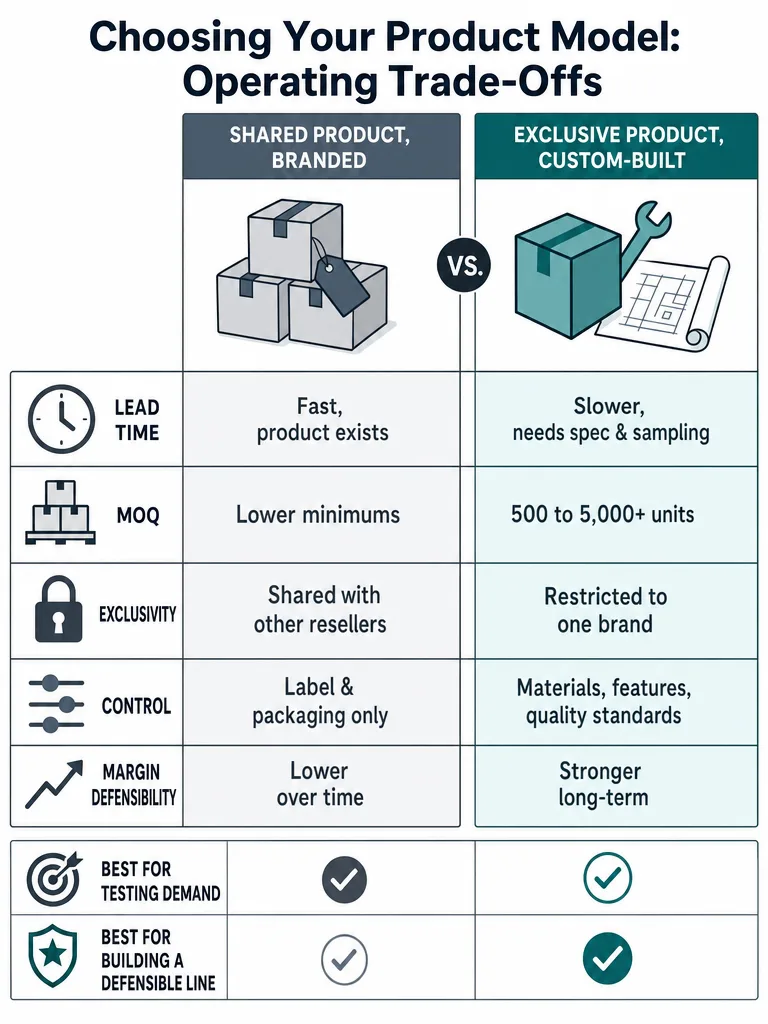
MOQ and Lead Time: Private Label vs White Label by the Numbers
White label ships faster and starts smaller; private label costs more time upfront in exchange for a product that's yours. Importivity's comparison puts typical private label minimum order quantities at 500 to 5,000+ units, against 25 to 500 units for white label. Lead time follows the same pattern: private label runs 8 to 16 weeks for specification, sampling, and approval, while white label typically moves in 1 to 4 weeks because the product already exists.
| Factor | White label | Private label |
|---|---|---|
| Typical MOQ | 25 to 500 units | 500 to 5,000+ units |
| Typical speed to market | 1 to 4 weeks | 8 to 16 weeks |
| Upfront work | Branding, packaging approval | Spec, sampling, testing, tooling approval |
| Who else can buy the same product | Other resellers, often | No one, if exclusivity is agreed |
Those numbers matter for cash flow and shelf timing before they matter for anything else. A promotional distributor working a Q4 program with a fixed ship date can't absorb a 16-week private label lead time if the order lands in September. A marketplace seller testing a new category doesn't want 2,000 units of something unproven sitting in a warehouse.
Margin and Pricing Power: Which Model Protects Your Price Longer?
Private label protects your price for longer because no other seller can source the identical item. Gembah's comparison notes that white label margin potential depends heavily on branding, channel, and supplier price, while private label "can support stronger pricing when the product offers clear differences." White label margin erodes as more resellers list the same core product and compete on price alone; private label margin holds because the product itself isn't shoppable elsewhere.
A private label product only holds its price if the exclusivity behind it is real, not assumed. Scale is part of why buyers keep choosing the private label route despite the cost: Centric Software reports that private label grocery products already make up 20% of all grocery sales, a figure analyst firm Alvarez & Marsal expects to climb to nearly a quarter by 2030, and Grand View Research put the 2023 market size of private label packaged grocery goods at more than $393 billion. A 2024 McKinsey survey cited by Centric Software found that 92% of consumers planned to buy private label goods within the year. None of that volume happens if the products aren't differentiated enough to justify a price above the generic version.
If you're weighing which model fits a specific line, send us what you're sourcing and we'll help scope where the exclusivity actually pays for itself. Tell us what you sell
Is White Label or Private Label Better for Testing Demand?
White label is the right call when you need to know if a product sells before you commit real capital to it. Gembah's own quick-answer framing puts it directly: choose white label to "launch fast, keep development simple, and test a market with lower upfront effort," and save private label for when you're ready to build differentiation and long-term brand defensibility.
That maps onto the MOQ and lead time gap from the previous section. A 25 to 500 unit order and a 1 to 4 week turnaround, per Importivity's figures, means you can put a real product on a real listing, see actual sell-through, and cancel or pivot without a five-figure tooling loss hanging over the decision.
The trade-off shows up in what the sales data actually tells you. You're selling a product other resellers can also list, so early sell-through mostly measures whether the category sells at all, since you're sharing that listing environment with competitors carrying the same item. Use a white label run to gauge demand. Don't extend it into a forecast of the margin a differentiated product could eventually command.
How Much Product Control Do You Actually Need?
Product control splits into two tiers, and most buyers only need the first one. Gembah's comparison draws the line clearly: white label customization is "mainly branding, packaging, color or other limited options," while private label gives the buyer control over "materials, features, packaging and quality standards." Centric Software's breakdown goes further on the private label side, noting the retailer controls "every aspect of the product, from ingredients to packaging design."
That's a wide gap in practice. Changing a logo, a color, or a box design is a white label change. Changing the material a product is made from, a formula, a structural component, or a performance spec is a private label change, and it requires the manufacturer to build or adjust something rather than just print a new label.
SVI Global's comparison makes the same split: private label products are manufactured to the brand's own requirements, with the buyer defining materials, structure, performance, design, and packaging from the start. If your actual need is a different box on the same item inside it, you're describing white label with better packaging, not private label. If you need a different formula, material, or feature set, packaging changes alone won't get you there.
What Needs to Be in Writing to Make Private Label Exclusivity Real
Exclusivity in private label comes from a specific contract clause, not from the fact that a factory built something to your spec. Shopify's guide notes that private label contracts often include exclusivity agreements that specifically restrict the manufacturer from selling that product to other brands. Without that clause in writing, "private label" can mean nothing more than a spec the factory happened to make for you once, with no obligation stopping them from selling a near-identical version to the next buyer who asks.
Beyond the exclusivity clause itself, buyers negotiating a private label program typically need to settle who owns the tooling or molds if a specific one was built for the product, whether the specification and any custom formula or design count as the buyer's intellectual property, and what happens to that agreement if volume drops below a minimum. Public detail on standard boilerplate for these terms is limited as of this writing; the sources available describe the existence of exclusivity agreements without laying out full sample language. Confirm the exclusivity clause, tooling ownership, and IP terms as three separate lines before signing, not one bundled assumption.
When to Start White Label and Move to Private Label Later
The common path buyers use is to launch white label to validate that a category sells, then shift to private label once volume can absorb the higher minimum order quantity and tooling investment. This sequencing follows directly from the numbers already covered: a white label test at 25 to 500 units and a 1 to 4 week lead time, per Importivity's figures, lets you confirm demand before committing to the 500 to 5,000+ unit minimums and 8 to 16 week lead times that private label typically requires.
The sources reviewed for this piece don't lay out a formal volume threshold for when to make that switch, so treat any specific unit count as a business decision rather than a published rule. What is consistent across the comparisons is the logic: white label buys a demand signal cheaply, and private label buys margin protection and exclusivity once the demand is confirmed and worth defending.
The risk in this path is timing the switch too late. If a white label product is selling well, competitors sourcing from the same factory can list an identical item at any point, and every month spent waiting to move to a private label spec is a month your pricing stays exposed to that competition.
How to Choose Between Private Label and White Label for Your Business
The decision runs through five checks, in order: exclusivity need, control need, volume, timeline, and risk tolerance for the launch.
- Exclusivity. If a competitor buying from the same factory would meaningfully hurt your pricing or positioning, you need private label with an exclusivity clause in writing. If not, white label is enough.
- Control. If your requirement is a packaging or branding change only, white label covers it. If you need a different material, formula, feature, or quality standard, only private label gets you there.
- Volume. Private label minimums run 500 to 5,000+ units against white label's 25 to 500, per Importivity's comparison. Confirm your order size supports the higher minimum before committing to a private label spec.
- Timeline. Private label's 8 to 16 week lead time versus white label's 1 to 4 weeks, from the same comparison, has to fit your launch date, promotional window, or replenishment schedule, not the other way around.
- Risk tolerance. White label is the lower-risk starting point for an unproven category. Private label is the higher-investment move once demand and margin data justify tooling and longer lead times.
| Decision factor | Choose white label | Choose private label |
|---|---|---|
| Competitor access to same product | Acceptable | Not acceptable |
| Product change needed | Branding, packaging, color | Materials, features, formula, quality standard |
| Order volume ready | 25 to 500 units | 500 to 5,000+ units |
| Launch timeline | 1 to 4 weeks available | 8 to 16 weeks available |
| Stage | Testing demand | Building a defensible line |
Businesses that land on private label after this checklist still have to solve manufacturing details, tooling, minimums, packaging, and import logistics before a single unit ships. That's exactly where a sourcing and import partner like Landfall Brands fits: turning a private label spec into a landed cost and a delivery date rather than leaving those pieces to be solved one supplier at a time.
Sourcing Considerations by Channel: Marketplace, Retail, Promotional, and Corporate Gifting Buyers
The same private label vs white label decision plays out differently depending on what breaks when the model is wrong for your channel. Public research comparing these models by buyer type is limited, so what follows applies the general findings above to each channel's specific failure points rather than citing channel-specific studies.
Marketplace sellers on Amazon and similar platforms live or die on replenishment. Going out of stock hurts a listing's ranking and rebuilding it takes time, so a private label program's 8 to 16 week lead time has to be planned around reorder points well before inventory runs low, not after. White label's shorter cycle gives more room to correct a bad reorder estimate.
Retail chains and buying groups reviewing a category usually want one supplier covering the whole line rather than managing a different factory relationship for every SKU. That preference pushes toward private label programs built with control over specification across the category, provided volume supports the higher minimums.
Promotional distributors and corporate gifting programs run on fixed delivery dates tied to an event, a launch, or a season. A missed date can cancel the program outright rather than just delaying a sale. White label's 1 to 4 week turnaround gives more scheduling cushion; private label's longer timeline only works if the order is placed with enough lead time built in against the promised date.
Private label launches for any of these buyers stall most often on the same details: manufacturing specifications, tooling, minimums, packaging, and import logistics. Sorting the private label vs white label decision first, before negotiating those details, keeps a program from being redesigned mid-launch.