InsightGuides11 min read
How to Write a Product Specification That Manufacturers Can Quote Accurately
A quote-ready spec keeps suppliers pricing the same assumptions, not filling gaps on their own. It also helps you compare quotes on price, lead time, and terms.

What details does a manufacturer need to quote a product specification accurately?
A product specification manufacturers can quote accurately fixes product identity, materials, dimensions, function, appearance, packaging, quantity, and delivery terms, then flags what's still unknown. Zetwerk's RFQ guidance and Source and Stock's quote-ready checklist agree on the structure: once every supplier is pricing the same fixed assumptions, quotes become comparable instead of each one filling gaps with a different guess.
Mechanical Power Inc., a contract manufacturing sourcing company, describes the quoting process as starting the moment a customer submits a Request for Quote. Everything the engineering team does after that, reviewing dimensions, materials, tolerances, and customizations, works from whatever the buyer put in that one document. A thin RFQ gets a thin engineering review and a guessed price.
Source and Stock's minimum quote-ready specification covers twelve fields: product purpose, product identity, materials, dimensions, function, appearance, pack configuration, packaging, labels and instructions, quantity, delivery, and open questions. Leaving any of these blank doesn't make the product cheaper to quote. It means the supplier picks the assumption, and you find out what they picked when the sample arrives or the invoice does.
A plain-language brief works fine for a simple finished good with no custom engineering or precision fit. Once a part has mechanical tolerances, a custom mold, electronic components, or anything that has to physically interface with another part, a written description stops being enough. Zetwerk's RFQ guidance lists part numbers, CAD files or engineering drawings, and a bill of materials as standard parts of a complete RFQ package alongside the written spec, because a tolerance stack or a mechanical interface can't be carried in a sentence. The supplier needs a drawing to quote the part your engineer actually designed, not their best read of your description.
A specification that answers every one of these fields before it reaches a supplier gets priced against real inputs instead of a supplier's own assumptions. Zetwerk's RFQ guide frames this as the core trade: the more detailed the request, the more reliable the quotation, because the supplier isn't estimating around risk it can't see.
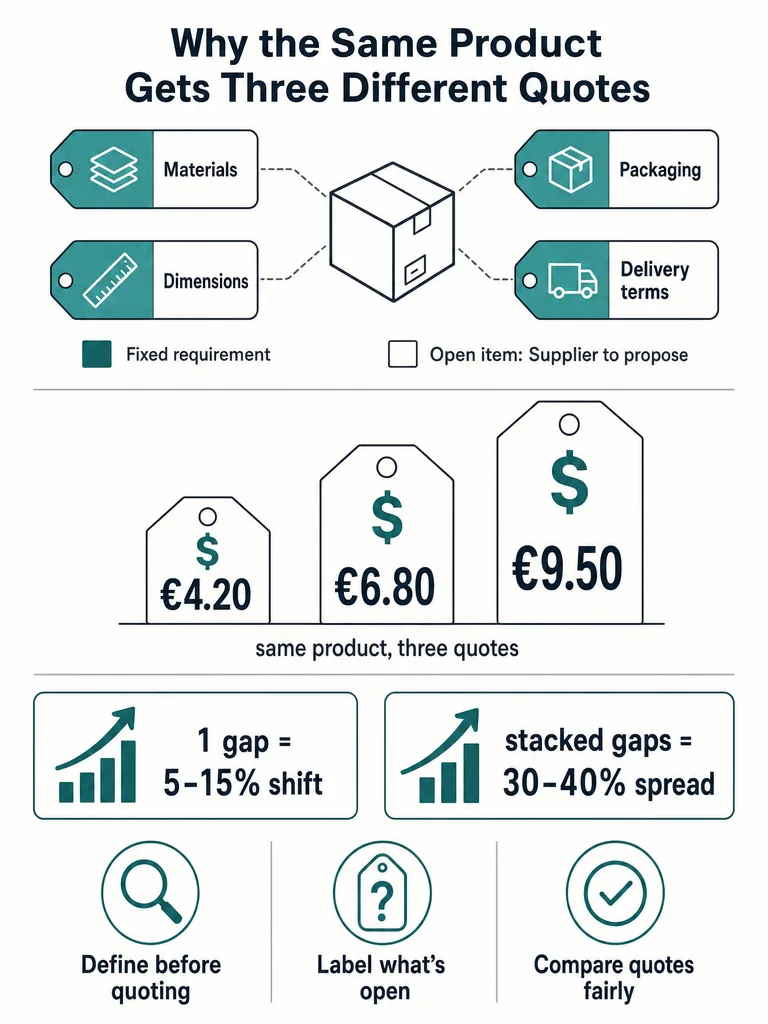
What makes supplier quotes come back wildly different for the same product?
A single missing detail, like an Incoterm or a material grade, can shift a quoted price by 5% to 15% on its own, according to Akacia. Stack two or three gaps, a loose tolerance plus no volume forecast plus an undefined finish, and the spread widens to 30% to 40% across suppliers who are technically answering the same request for quote.
Akacia illustrates this with a plain scenario: one buyer sends a loosely specified RFQ for what they believe is a single product, and three quotes come back at €4.20, €6.80, and €9.50. None of the three suppliers lied. Each one filled the gaps the buyer left open with a different assumption about material grade, finish, or test method, and priced accordingly.
The fix isn't a longer document. It's a more specific one. A spec that says "food-grade plastic lid" leaves wall thickness, impact resistance, and material grade open to interpretation; a spec that names the exact material grade, states a wall-thickness target, and names the test the part has to pass closes those same gaps before the supplier starts pricing. Akacia's underlying point is that specificity, not length, is what collapses three different quotes into one.
How do you label requirements so suppliers know what's fixed and what's still open?
Source and Stock recommends tagging every line in the specification with one of four statuses: Mandatory, Preferred, Supplier to propose, and Not yet confirmed. The label tells the supplier whether to price a fixed requirement or submit a recommendation, instead of guessing which one you meant.
Mandatory means non-negotiable and priced as stated: "Outer carton must hold 24 units, mandatory." Preferred signals a default the supplier can quote an alternative against: "Recycled kraft mailer box preferred; quote alternative if cost-prohibitive." Supplier to propose hands a decision to the supplier's expertise: "Closure mechanism: supplier to propose based on 500ml fill volume." Not yet confirmed flags something you genuinely don't know yet: "Final retail price point not yet confirmed, pending retailer feedback."
This matters because a specification with no status labels reads as entirely fixed to a cautious supplier and entirely flexible to an aggressive one. Neither reading is accurate, and the quote that comes back reflects whichever one the supplier happened to assume. Four labels, applied consistently line by line, remove that ambiguity before pricing starts rather than after a sample disappoints.
How should materials, dimensions, tolerances, and finish be written so suppliers don't guess?
Generic terms like "metal," "cotton," or "premium plastic" aren't quotable on their own, because they don't tell a supplier which grade, weight, or treatment to price. Akacia recommends naming the exact measurement point, unit, nominal value, and tolerance for anything that affects cost or fit, and stating whether that measurement applies before or after assembly, washing, or packing. The values below are a generic format template, not data from a specific product; the surface-finish and load-test rows use Akacia's own worked examples, flagged where they do.
| Measurement point | Unit | Nominal value | Tolerance | Measured when |
|---|---|---|---|---|
| Critical dimension (example row) | mm | Set per part | ISO 2768-m, Akacia's recommended default for dimensions not individually called out | Before assembly |
| Surface finish | Ra (μm) | 1.6, Akacia's example of a measurable finish requirement | n/a | Final part |
| Functional load test | N (newtons) | 1000, held 60 seconds, Akacia's example | No permanent deformation | Final assembly |
| Material weight (example row) | gsm | Set per material grade | Stated per spec, not a universal figure | Before washing |
A surface requirement written as "Ra 1.6 μm" is quotable; "smooth finish" is not, because every supplier has a different idea of smooth. A functional spec written as "1000 N for 60 seconds, no permanent deformation" gives a test lab something to execute; "durable" gives them nothing.
Packaging and decoration specifics belong in this same section, not left for later. A blank product priced separately from its decoration setup carries different freight, misprint risk, and setup-fee assumptions than one decorated product quoted whole, a distinction covered in more detail in promotional products import pricing.
What volume and delivery information does a manufacturer need to quote unit cost and lead time?
Suppliers price the business relationship, not just the part, according to Akacia. A manufacturer quoting your unit cost needs to know how many units you're ordering now and how many you expect to order over the next three years, because tooling and setup costs get amortized against that total, not just the first purchase order.
- First order quantity. The number you're committing to now, which the supplier uses for the initial production run.
- Year one, two, and three forecast. Akacia's own worked example uses 2,000 units for the first order, 8,000 in year one, 15,000 in year two, and 20,000 in year three, a volume curve that lets a supplier quote tooling amortization honestly instead of padding the first order to cover a cost they can't verify.
- Call-off pattern. Whether you'll take the full order at once or draw down against it in scheduled releases.
- Delivery location. The port, warehouse, or address the goods need to reach, which determines freight routing and duty treatment.
- Required lead time. The date you need goods on hand, worked backward from a launch, a promotion, or a replenishment deadline.
A forecast that's wrong is still more useful to a supplier than no forecast at all. Leaving this section blank doesn't protect you from committing to a number. It just means the supplier picks a number for you, usually a conservative one that assumes you'll reorder small and prices tooling accordingly. Delivery date risk compounds the same way campaign timing does; see how to keep campaign merchandise on date for how a slipping schedule checkpoint shows up well before the ship date if it's tracked.
Which commercial terms have to be settled before you compare quotes?
Two quotes with the same unit price can represent very different total costs if the commercial terms underneath them differ. Zetwerk lists tooling ownership, setup fees, shipping inclusion, production lead time, payment terms, quality certifications, warranty, and production capacity as the factors that actually determine total cost, not just the number at the top of the quote.
| Term | What it determines | Why it changes total cost |
|---|---|---|
| Incoterm | Who pays and insures freight at each leg | FOB vs. landed pricing can hide freight and duty in a separate line |
| Tooling ownership | Who owns the mold or die after payment | Buyer-owned tooling can move between suppliers; supplier-owned often can't |
| Inspection requirement | Who verifies quality before shipment, and where | Third-party inspection adds cost but catches defects before freight is paid |
| Shipping inclusion | Whether freight is quoted in or billed separately | A lower unit price with freight excluded isn't comparable to one that includes it |
| Payment terms | Deposit percentage and balance timing | Affects cash flow and the supplier's own risk pricing |
| Certifications | Which compliance documents are included and verified | Missing certification requirements at quote stage means retesting later |
None of these terms show up in a bare unit price, which is exactly why two quotes that look close on paper can land at very different landed costs once freight, tooling, and payment terms are added in. This is also where the single-supplier-versus-multi-supplier decision gets made category by category; see one vendor vs many suppliers for retail categories for how that tradeoff plays out across total cost and supply risk.
What is the difference between an RFQ and an RFP in manufacturing?
A Request for Quotation (RFQ) is a formal document sent to suppliers once the product specification is already fixed, and suppliers respond mainly with price, lead time, and commercial terms. Zetwerk draws a clear line between the two: an RFQ assumes you already know what you want built, while a Request for Proposal (RFP) is used to find the best solution to a problem that isn't yet defined.
Sending an RFP when you actually need an RFQ is one reason quotes come back inconsistent. If the specification is still open on materials, dimensions, or function, suppliers responding to what looks like an RFQ will quietly treat it as an RFP and propose their own solution, which is exactly the kind of mismatched quote described earlier in this article. Fix the specification first. Send the RFQ second.
How do you check that two supplier quotes are pricing the same specification?
An accurate quote reflects a defined supply chain, not an assumption, as E-BI puts it, and the way to confirm a quote is accurate rather than assumed is to line up every commercial term side by side, not just the unit price. NetSuite and Cincom make a related point in their quoting guidance: a precise quote states price and terms clearly enough that a buyer can compare it and extend trust to the number, rather than treat it as a starting offer to negotiate down.
| Factor | Quote A | Quote B |
|---|---|---|
| Unit price | ||
| Tooling / setup fee | ||
| Lead time | ||
| Incoterm | ||
| Inspection included | ||
| Certifications included | ||
| Payment terms | ||
| Warranty |
Fill this table from each supplier's actual quote document, not from memory of a phone call. A quote that skips rows, leaves the Incoterm unstated, or never mentions tooling ownership isn't necessarily a bad quote. It's an incomplete one, and the gap belongs back on the supplier's desk as a question before it belongs in your comparison. Zetwerk's evaluation approach treats tooling, shipping, lead time, payment terms, certifications, warranty, and capacity as the full set of factors that make quotes genuinely comparable, which is longer than most buyers check on a first pass.
How does the approved specification carry into sampling, purchase orders, and production?
Zetwerk's guidance is specific on this point: an accepted quotation should convert into a purchase order with the specifications, pricing, delivery dates, and terms documented clearly, so the version everyone agreed to at quote stage is the version that gets built. A specification that lives in an email thread and a different one that lives on the PO is how a "Preferred" packaging line quietly becomes whatever the factory had on hand.
- Freeze the specification version. Once a quote is accepted, that exact document, tolerances, status labels, and all, becomes the reference version. No further edits without a new quote.
- Attach it to the purchase order. The PO should reference or include the frozen specification directly, not a summary of it.
- Carry tolerances and packaging lines into inspection criteria. Whatever was written as Mandatory in the specification is what gets checked at inspection, measurement point by measurement point.
This is the step where a specification stops being a sourcing document and becomes a production program. Whether a product runs as a full private label build or starts as a lighter white label test changes how much of the specification gets locked down before the first order; see private label vs white label for that distinction, and what stalls a private label launch for where incomplete specifications tend to cause delays after the quote stage.