InsightGuides9 min read
Category Price Architecture: Good, Better, Best
Price architecture is the structure shoppers read before they compare individual SKUs. Use tiers, KVIs, and opening price points to protect value and margin.

What Is Category Price Architecture?
Price a category wrong, and shoppers write off the entire assortment as cheap or overpriced, no matter what any single SKU actually costs. Category price architecture is the deliberate structure of tiers, the price gaps between them, and the handful of key value items shoppers use to judge the whole category's worth, according to CPG Scout.
Hyper-Trade's pricing resource HPTpedia frames the same decision from the retailer's side: price structure sets the relative weight of Good, Better, and Best items in a range, driven by the price image a retailer or category buyer wants the set to carry. Some retailers apply that Good-Better-Best split to brands rather than individual products, which means defining a price reference point and checking that each brand actually has pack types to support the intended image.
Shelf position matters as much as the price tag. HPTpedia notes that giving more space to cheaper items, or placing them first in a shopper's path through the set, can shift how cheap or expensive the whole category looks, independent of what any single SKU costs. An analysis published on SSRN found that pricing and ordering decisions made at the category level, rather than brand-by-brand or on a simple cost-plus basis, can produce higher profits in a dynamic retail setting, the commercial case for treating price architecture as one decision instead of many.
Good-Better-Best or a Five-Tier Price Ladder?
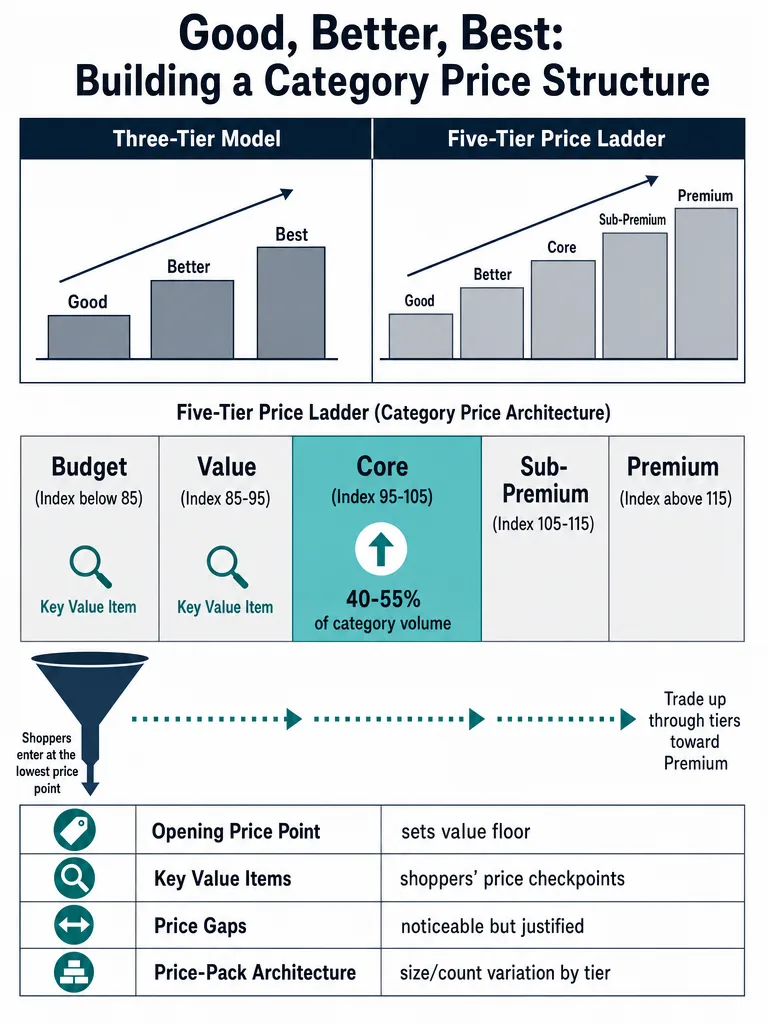
A three-tier Good-Better-Best structure is a simplified read on the same decision a five-tier price ladder makes with more precision. RGM Academy's indexed framework scores every SKU against the category's volume-weighted average retail price, set at an index of 100, then sorts items into five bands: Budget, Value, Core, Sub-Premium, and Premium.
| Tier | RGM Academy Price Index | Typical Role in a 3-Tier Structure |
|---|---|---|
| Budget | Below 85 | Often the opening price point, or skipped entirely |
| Value | 85-95 | Maps to "Good" |
| Core | 95-105 | Maps to "Better"; usually the volume anchor |
| Sub-Premium | 105-115 | Maps to "Best" |
| Premium | Above 115 | Maps to "Best" or a trade-up rung above it |
A specialty or high-end line can index at 150, 200, or higher, according to RGM Academy, which is why Premium has no upper bound in the five-tier model.
A three-tier structure fits a short assortment with one clear trade-up story: a basic version, a mid version, a premium version. The five-tier ladder earns its keep once a category has enough SKU count and price spread that "Better" is actually masking two different shopper groups, or when buyers need a common index to compare price position across suppliers rather than relying on raw dollar figures. The available research doesn't break this choice down by channel; it doesn't specify how a marketplace listing, a retail chain's SKU audit, or a promotional program should apply either model differently.
How Many Good-Better-Best Options Do You Need?
There's no fixed SKU count that belongs in Good, Better, or Best, but there is a volume benchmark for where the bulk of an assortment should land. Core, the tier priced closest to the category average, typically carries 40 to 55 percent of category volume, according to RGM Academy's five-tier framework. That's the clearest available guide to where most SKUs and most selling effort should concentrate: the mainstream tier, not the opening price point and not the premium trade-up.
None of the available research sets a fixed SKU count for Good, Better, or Best. What HPTpedia specifies instead is the method: measure each segment's sales contribution, trend, and margin impact, then size the assortment to match what the data shows rather than to an arbitrary rule of thumb.
A multitiered structure also does double duty on margin. Harvard Business Review's 2018 look at Good-Better-Best pricing found that the approach avoids overreliance on discounts to win price-sensitive shoppers, while still giving higher-end customers a reason to spend more.
In practice, that leaves SKU count as a measurement question, not a starting formula. Add or cut SKUs in whichever tier is actually carrying volume and margin against that 40-55 percent Core benchmark, not the tier that looks best in a planogram.
What Is an Opening Price Point?
The cheapest SKU in a category only works as an opening price point if shoppers actually believe it's real quality at a fair price, according to CPG Scout. That item sets the value floor and anchors the whole set's price image. A credible opening price point is the lowest price at which a shopper still trusts the product as genuine quality for the money.
Get that credibility wrong in either direction and the category pays for it. Price the opening item too high and you lose the shopper comparing purely on price, which hurts most in what HPTpedia calls traffic categories, the ones where price image has to be strong because shoppers judge the whole store by them. Price it too low, or stock too many units of it relative to the rest of the set, and HPTpedia's research notes that allocating more shelf space to cheap items, or placing them first in the shopper's path, pushes the entire category's perceived image downward, even when the mid and premium tiers haven't moved.
What Are Key Value Items?
Shoppers judge an entire category by the price of a handful of SKUs they already know the going rate for, and those SKUs are key value items, or KVIs. CPG Scout's framework treats KVI pricing as a lever on the whole set: move the price of a true KVI and shoppers recalibrate what they think the rest of the category costs, for better or worse.
That makes KVI selection a research question before it's a pricing question. The items that function as KVIs are usually ones a shopper already carries a reference price for from memory or a competitor, which means they're rarely the newest or most differentiated SKUs in the range. Pricing a KVI aggressively while pricing the rest of the category to plan is a standard way to protect blended margin while still winning the shopper's trust on value.
How granular this logic can get varies by system. Oracle's pricing-dimension documentation describes structures that support up to 30 segments for categorizing pricing logic in a single framework, far more granular than a shopper-facing KVI list needs to be. It shows the ceiling: category price logic can scale from a handful of KVIs up to dozens of structured pricing segments depending on how much precision a business needs.
How Wide Should Price Gaps Be Between Tiers?
No published benchmark sets a fixed dollar amount or percentage for the gap between Good and Better, or Better and Best, in the available research. What the sources establish instead is the principle: HPTpedia ties gap sizing to price image, the perception a retailer or category buyer wants the whole set to project, and price image isn't the same across categories. It has to be strongest in traffic categories, where shoppers judge the whole store or program on price alone.
Beyond that principle, the research available here doesn't specify an exact gap-sizing method in dollars or percentages. Buyers sizing gaps today are working from landed cost and competitive pricing data, not a published standard.
What Is Price-Pack Architecture?
A single-serve pack, a value multipack, and a bulk case of the same product can each anchor a different tier without competing head-on, as long as the price-per-unit story differs enough to matter. CPG Scout calls this deliberate spread across pack sizes, counts, and formats price-pack architecture, and it's one of the few ways a single brand can span Good, Better, and Best without one SKU eating another's sales.
The available research here covers the pricing side of price-pack architecture only. It doesn't address how manufacturing minimums, packaging specs, or import logistics constrain which price tier a given pack format can actually reach once it's sourced and landed. That's a separate operational question from the pricing model itself, and worth checking before building a price-pack plan around a size or format that hasn't been costed.
Buyers choosing between a faster private label build and a more customized one should weigh the tradeoffs between private label and white label before locking a price-pack plan, since the packaging and specification work behind each option changes which tiers are realistically reachable.
How to Test and Adjust Your Good-Better-Best Mix
A Good-Better-Best mix isn't something you set once and leave alone. HPTpedia's framework treats it as something a category buyer measures and rebalances on a cycle, using sales contribution, trend, and margin impact by segment as the inputs. Here's the sequence:
- Pull sales contribution by tier. Calculate what share of category volume and revenue each of Good, Better, and Best actually generated last period, not what the planogram assumed it would.
- Check the trend, not just the snapshot. A tier holding share but losing trend is an early signal before it shows up in margin.
- Overlay margin impact. A tier that drives volume but erodes blended margin needs a price adjustment or a cost-side fix, not more SKUs.
- Compare against the Core volume benchmark. RGM Academy's five-tier model treats 40 to 55 percent of volume in Core as standard. If Core is running well below that range, treat it as a hypothesis worth testing, not a conclusion: the opening price point or the premium tier may be pulling volume that would otherwise sit in Core. Confirm it against the trend and margin data from steps 2 and 3 before changing a price.
- Adjust SKU count and price gaps in the underperforming tier, then hold the rest of the structure steady so you can tell which change caused which result.
This measurement cycle runs on its own timeline, separate from sourcing and delivery execution. A private label launch or a promotional program carries its own scheduling risks that a pricing review won't catch; those are covered separately in a look at what stalls a private label launch and in guidance on keeping campaign merchandise on date.