InsightGuides8 min read
Retail-Ready Packaging: Check the Carton, Label and Case Pack Together
Use one written brief to compare supplier quotes for the same carton. Review seven physical sample checks, shipment handoffs and what to reopen when a pack changes.
What should I check about retail-ready packaging before I approve it?
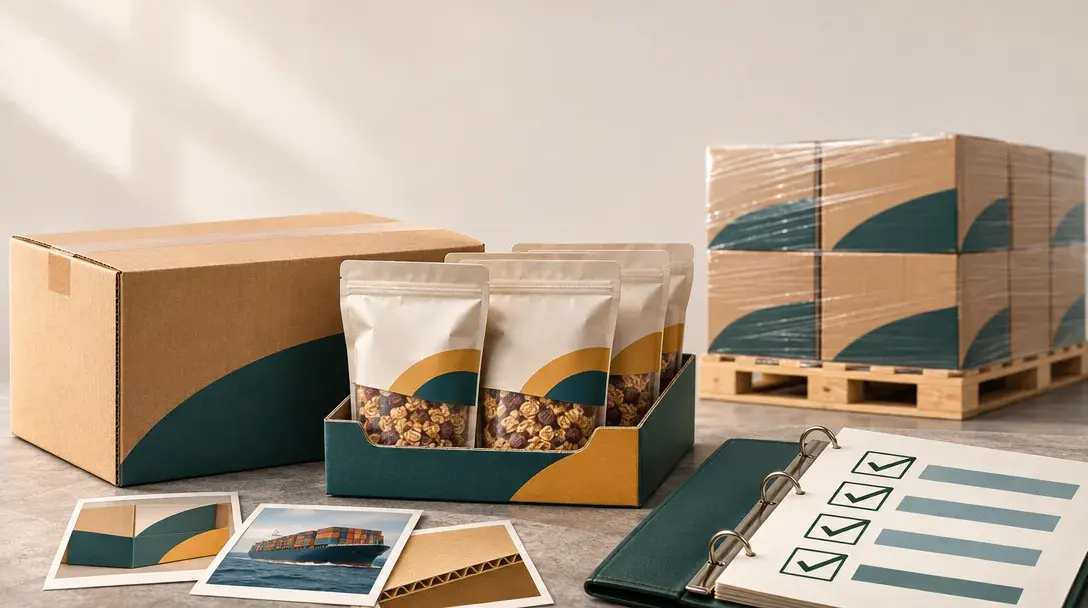
Check that the carton, label and case pack match the destination's written requirements, and approve them together as one record. Retail-ready packaging is product delivered in packaging optimized for efficient stocking and sale, as Wikipedia defines it. A good-looking tray is not shipment approval; the paperwork and cartons around it decide that.
So what does "retail ready" mean in practice? The 8th & Walton blog describes it as a box, tray, sleeve, bin or other display that the product ships in and that can go directly onto the shelf. Retailers ask for it to cut stocking labor. Wikipedia notes that they commonly specify pallet size, barcode format and placement, RFID tags and the strength of the corrugated shipping container.
Those specifications differ by buyer. Per the same Wikipedia entry, Costco, Target and Walmart each publish packaging standards that are similar but not identical. A pack approved for one is not automatically approved for another.
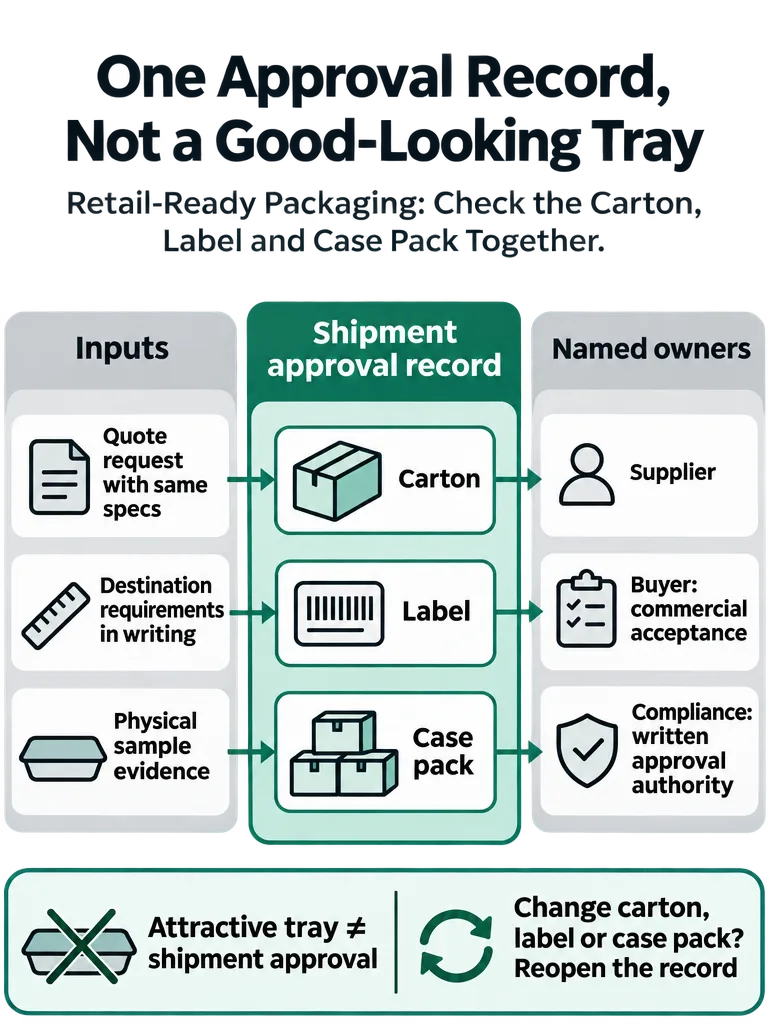
That is why the review has three parts that must agree:
- Carton: structure, dimensions, weight and markings.
- Label: content, identifiers and placement.
- Case pack: quantity per case, and how the case fits the shelf and the pallet.
What does the retailer's manual actually tie together?
A retailer's vendor manual treats data and cartons as one compliance check. The DXL Group quick-start checklist, in its Private Label Vendor Manual, puts EDI readiness, UPC data, ASN accuracy and UCC-128 approval next to carton quality, dimensions, weight, markings, SKU integrity and label placement.
Destination XL Group, Inc. issues that manual. It is one retailer's example, not an industry rule. It shows how a carton problem and a data problem can land in the same inspection.
The manual tells vendors to confirm all of these before packing, routing or shipping. It also says to obtain written approval before shipping any order that misses a stated requirement.
The research has gaps you should plan around:
- The excerpt names the carton checks but gives no dimensions, weight limits or label coordinates for any destination. Get those from the retailer's own current manual.
- The sources mention UPC and GTIN identifiers and GS1 labeling but do not give GS1's rules.
- Amazon's carton and label requirements are not covered here. The Dropship Corporation guide says only that Amazon sellers need to understand FNSKU labels, UPC or GTIN requirements and carton requirements. Do not carry DXL's rules over to Amazon.
What belongs in the same quote request so suppliers price the same carton?
Every supplier should quote the same written brief. FastLane's sourcing guide warns that without one, a supplier may quote a lower-grade material, a different carton configuration or an incomplete decoration process. The result looks like a pricing win until the goods arrive or change orders begin.
| Quote item | Fact to state | Why it changes price |
|---|---|---|
| Dimensions and materials | Carton and tray size, material grade | A supplier can quote a lower-grade material than the one you meant |
| Artwork | Approved file and revision | An incomplete decoration process is a common gap |
| Labeling | Label content, identifiers, placement | Left out of the brief, it returns later as a change order |
| Packaging and case configuration | Units per case, tray or shipper format | Suppliers quote different carton configurations |
| Quantity tiers | Opening order, reorder, upside | Price changes when volume rises |
| Destination | Receiving address and delivery model | Drives the freight and tax lines |
| Target delivery date | Must-arrive date, with production and transit milestones kept separate | Sets the schedule the quote must meet |
| Cost split | Product, packaging, freight, taxes, and what is included or excluded | Makes quotes comparable line by line |
Illustrative only: if one supplier quotes a six-unit case and another a twelve-unit case, the two prices are not comparable until the case pack is stated in the brief.
Back the brief with a SKU specification sheet that lists packaging, labeling, approved artwork and pass-fail criteria. FastLane also recommends a version-controlled approval record, so the factory works from what you approved. Our guides on the private-label RFQ checklist and how to write a product specification that manufacturers can quote cover each in more detail.
How do you approve a shelf-ready pack beyond an artwork proof?
An artwork proof shows what the pack looks like. Approval needs physical evidence that the pack works through receiving, identification, opening, shelf placement, shopping and removal of the empty pack. That sequence comes from PACKRIVA's retail-ready packaging guide. The checks below combine PACKRIVA's guidance with The Retail Packaging checklist.
- Build a structural sample with the actual product. A studio mockup does not prove fit.
- Have someone who has never seen the pack open it. Tear strips and perforations must be intuitive.
- Check case identification on at least two adjacent faces. Staff need to identify the SKU quickly.
- Look at the tray with half the product removed. Visibility, access and stability change as stock falls.
- Scan-test the barcode on the actual printed substrate. A scan from the screen proof does not count.
- Confirm planogram dimensions in writing, where the retailer uses them.
- Specify stacking strength against pallet load, not against the weight of the contents.
Review transport protection and display performance separately. PACKRIVA notes that changes making a pack easier to open can affect how it behaves closed, and that reinforcement can make opening harder.
Approval for one destination is not approval for another, since shelf arrangements and opening rules differ. The sources give no transport-test protocols or pass thresholds, so ask the retailer for its test standard.
Who owns each handoff from quote to shipment?
Each handoff needs a named owner and a record that closes it. The worksheet below is a proposed structure, not a documented program. Adjust the owners to your contracts. The record column follows the launch checklist from Racklify, which says to record artwork, UPCs or GTINs and case dimensions in the warehouse or ERP system before the first pallet ships.
| Handoff | Proposed owner | Record that closes it |
|---|---|---|
| Carton revision | Buyer's program lead, with the supplier | Spec sheet version and structural sample sign-off |
| Label artwork | Buyer, with the supplier | Approved artwork file and scan-test result |
| Case configuration | Buyer | Case dimensions and quantity entered in your systems |
| Factory packout | Supplier or factory | Packout confirmed against the approved spec version |
| Shipment data and ASN | Whoever transmits shipment data | Data matched to cartons actually packed |
| Exception approval | Retailer's compliance authority | Written approval before shipment |
If carton, label and freight sit with different suppliers, this worksheet has more owners and more gaps. Our piece on one vendor vs many suppliers for retail categories covers that trade-off.
What does a packaging miss cost, and what should the quote say about it?
A packaging or data miss can cost more than the carton. The DXL manual (modernized September 2026) lists the charges below. They are one retailer's figures, not industry rates. The sources do not provide a model linking a case-pack change to landed cost.
| Miss | DXL charge |
|---|---|
| Listed EDI noncompliance (missing or wrong ASN, unconsolidated POs) | $100 per PO plus $1 per carton |
| Overseas ASN not sent within 7 days (container) or 3 days (air) | 5% invoice deduction, capped at $2,000 per ASN |
| 810 invoice missing or in error | $8 per case, capped at $2,000 per shipment |
| Unauthorized late shipment (enforced from 06/24/2026) | 1.0% of FOB value per day, per shipment |
| Weight or cube variance against the retailer's system | Incremental freight charged back in full, $100 minimum |
On late shipments, the manual also says time-sensitive orders may move from ocean to air, with the vendor responsible for the difference.
The quote should say who bears each chargeback class and who owns each delivery milestone. Production and transit dates should sit on separate lines. Our guide on how to keep campaign merchandise on date shows how to plan those checkpoints backward from the due date.
What happens when the carton, label or case pack changes after approval?
Any change to carton structure, label or case quantity reopens the approval. The approved record no longer describes what will ship, and the shipment data, scan results and shelf fit all depend on it. Run the change through these steps:
- Name the trigger: carton structure, label, or units per case.
- Issue a new spec sheet version and retire the old one.
- Reapprove the artwork if the label or carton print changed.
- Check the identifiers. The sources give no GS1 rules on when identifiers must change, so confirm with the retailer or GS1 instead of assuming.
- Update case dimensions in your systems (the WMS or ERP, per Racklify).
- Rebuild the shipment data so the ASN and weight and cube figures match what will ship.
- Repeat the barcode scan test and the shelf-fit check on a new sample.
Skipping a step is how an approved pack ships as an unapproved one. For the wider pattern, see what stalls a private label launch.
If you want help turning this into a quote, send us the specification, your landed-cost target and the required delivery date at landfallbrands.com/contact. Landfall Brands plans packaging, import and delivery together for product programs, so the carton, label and case pack are priced against one date.
Sources
- Shelf-ready packagingen.wikipedia.org
- images.dxl.comimages.dxl.com
- dropshipcorporation.comdropshipcorporation.com
- fastlanetrade.comfastlanetrade.com
- racklify.comracklify.com