InsightGuides8 min read
Who Owns the Tooling? Questions to Settle Before a Factory Deposit
Use a tooling decision record to document ownership, maintenance and release terms before paying a deposit. Check whether a new factory can run the tool before moving it.
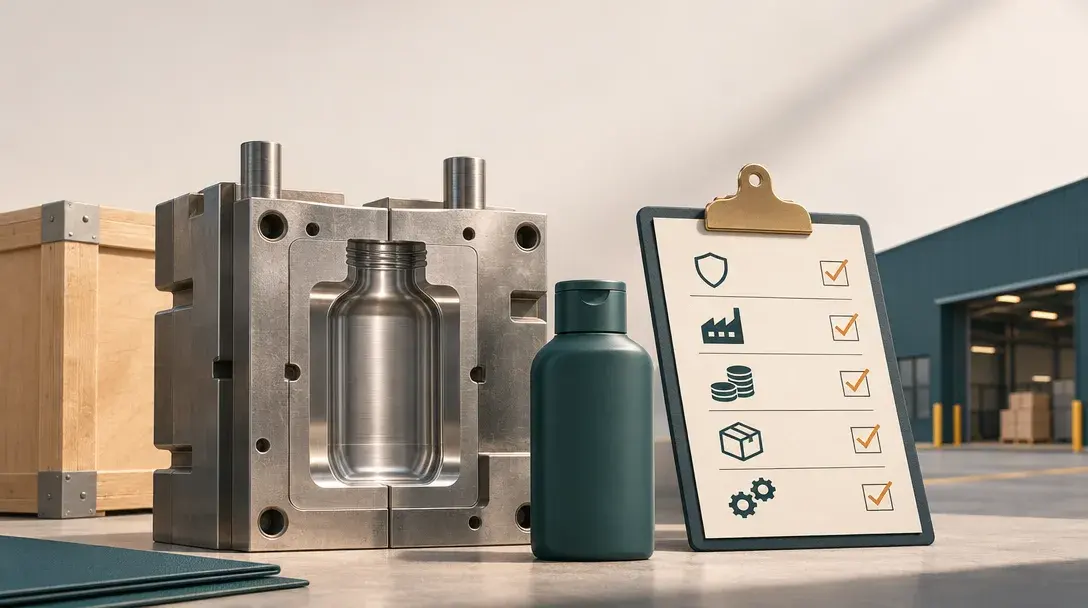
Who owns the tooling when you pay for it?
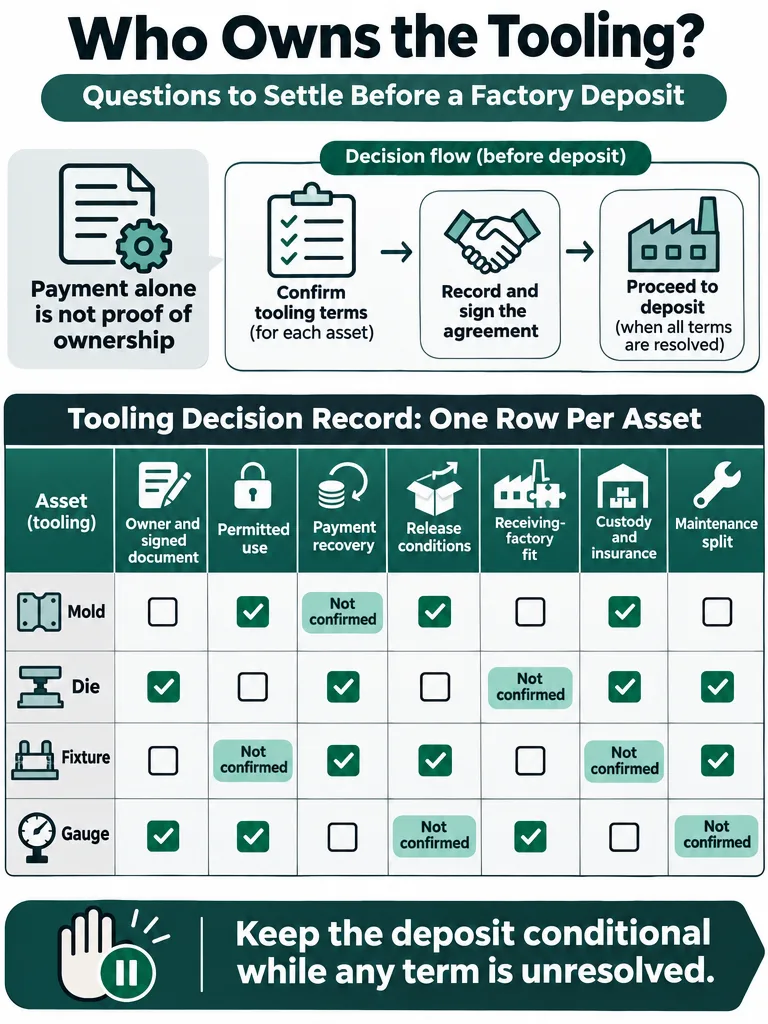
Payment alone does not establish who owns the tooling. The questions to settle before a factory deposit are the intended owner, the ownership-transfer milestone, use rights, custody, maintenance and exit terms. Boehm Pressed Steel says paying customers usually own tooling; GoodPrints3D says payment doesn't tell you.
Both can be right. Boehm describes the common case: the customer pays, the tool is the customer's asset, and it sits at the stamper's plant. GoodPrints3D covers the case where a quote says nothing. It notes that a paid-for jig, fixture or gauge may be buyer-owned, supplier-owned or licensed for one job. The invoice word "tooling" does not tell you which.
Write the owner and the transfer milestone into a signed document before any money moves.
The sources do not cover how ownership transfers, liens or remedies work in any particular country. Treat the questions below as what to put in writing, then have a lawyer in your jurisdiction review the wording.
What does the tooling line on the quote actually buy?
A tooling line can cover physical tools (molds, dies, jigs, fixtures, gauges) and non-physical items such as working files, production methods and setup work. Each is a separate deliverable. GoodPrints3D points out that buying a fixture does not necessarily include the supplier's methods, working files or general templates.
Ask the supplier to split the charge. JiangSourcing's comparison worksheet lists samples, artwork, molds, tooling and packaging setup as separate one-time charges, with refund conditions where offered. Its rule for gaps: write "not confirmed," because a blank cell must not be read as zero cost.
Do not let the trade term stand in for title. Inside China Works notes that an Incoterms rule allocates delivery, costs and risk, but does not itself decide payment terms or title. A "FOB" quote tells you nothing about who owns the mold.
Which document should name the owner of each tool?
A separate tooling schedule, signed by both parties and referenced from the purchase order, should name the owner of each tool. GREAT HUB, in a guide published October 23, 2026, says a single PO line reading "tooling" proves very little. Its schedule gives each tool its own row:
| Field | What to record |
|---|---|
| Tool reference | Your code, the supplier's code, any marking on the tool |
| Description | Tool type, the product it makes, capacity such as cavity count |
| Price and payment milestone | Amount, currency, the event that triggers payment |
| Named owner | The owner, plus the holding terms the supplier signs |
| Condition at handover | Photographs, trial results, approved sample reference |
| Storage location | Site, building, who is responsible for safekeeping |
If you supplied the drawings, GREAT HUB says to state that design files and any modifications follow the same ownership arrangement.
Also record three facts from the quote. Who is the contracting seller and payment beneficiary? Who makes the tool? Where will it be held? Inside China Works lists the contracting seller, the proposed manufacturing site and any outsourced steps as quote fields for this reason.
Harris Sliwoski LLP publishes a template international tooling ownership agreement. Use it as a discussion framework only. It needs country- and deal-specific changes, and it covers ownership after all fees are paid, not design arrangements or payment structure.
May the factory use your tool for other customers' orders?
Dedicated or shared use is a term to write down, not a default to assume. Record whether the tool is dedicated to your orders, whether other buyers' products may run on it, how production slots are prioritized, who may inspect it and what usage counts you receive. Add confidentiality and third-party production limits, then have counsel in your jurisdiction review them.
- Dedicated or shared. State whether the tool is dedicated to your orders. If so, say the supplier may not run other buyers' products on it (GREAT HUB).
- Slot priority. Record how production slots are prioritized when you need capacity.
- Inspector access. Name who may view the tool, your representative or a third-party inspector, and what notice a visit requires.
- Usage counts. Ask for cycle or shot counts with each order, so wear is discussed against recorded usage rather than memory.
- Confidentiality and third-party production. The Harris Sliwoski template addresses confidentiality, restrictions on third-party production, and confidentiality duties when a third party fabricates the tooling. Check each against your deal.
- Know-how. Say what the tool payment does not buy. Per GoodPrints3D, the supplier's methods and working files may stay with the supplier unless the document says otherwise.
Who pays for maintenance, wear repairs and misuse damage?
Maintenance responsibility splits into three charge categories: scheduled maintenance, normal-wear repair, and damage from misuse or unauthorized production. GREAT HUB says to write down who pays for each before anything wears. The sources name the categories but not the payer, so each one is a negotiated term. GREAT HUB also recommends a maintenance log kept against the tool reference.
| Charge category | What it covers | Responsible party |
|---|---|---|
| Scheduled maintenance | Planned upkeep | Negotiate and record |
| Normal-wear repair | Wear from producing your orders | Negotiate and record |
| Misuse or unauthorized production | Damage from misuse or running unapproved products | Negotiate and record |
| Replacement | A tool that is worn out, damaged beyond repair or lost | Negotiate and record |
Replacement is a separate point from repair. The sources reviewed do not set a standard payer, replacement cost or tool life, so none is stated here. Get each in writing from your supplier.
Request design changes as a separate quoted modification, not folded into a maintenance invoice.
Storage needs its own terms. Record the physical location, the protection against corrosion and handling damage, who bears the risk of loss, and whether the tool is insured. GREAT HUB suggests refreshing photographs periodically as evidence of condition.
Should you amortize tooling into the part price?
Amortize tooling only if the lower upfront payment is worth the higher unit price, and only once the recovery period, cancellation balance and ownership-transfer terms are written down. Boehm Pressed Steel notes the trade-off: amortizing lowers the upfront payment but raises the per-part price until the cost is recovered, and early cancellation may leave a balance payable.
To see the trade-off Boehm Pressed Steel describes, take an invented illustration, not a sourced figure or market price. A tool quoted at $10,000 and recovered over 10,000 parts adds $1.00 per part. If the program stops after 4,000 parts, $6,000 is still unrecovered. Whether you owe it, and whether you then own the tool, depends entirely on the signed terms.
Ask these before you choose:
- What balance remains if volume falls short or the program ends early?
- When does ownership transfer: at deposit, acceptance, or final payment?
- Does the part price drop once the tool is recovered, and where is that written?
Leaving the cancellation balance or the ownership-transfer milestone open is one way a program stalls before production. See what stalls a private label launch for seven costly misses.
What happens to the tooling if you change suppliers?
Changing suppliers needs two separate confirmations, because a right to retrieve a tool does not prove another factory can run it. Release requires agreed notice, packing and crating responsibility, costs, export formalities and settlement of outstanding items (GREAT HUB). Compatibility requires checking press bed dimensions, tonnage and feed systems (Boehm Pressed Steel).
Confirm the release arrangements and the receiving-factory compatibility with these six items:
- Notice and release. Agree the notice period and which outstanding items must be settled before release, so release terms cannot be renegotiated under pressure (GREAT HUB).
- Packing and crating. Say who packs and crates the tool and who pays for it.
- Export formalities. Say who handles them if the tool leaves the country.
- Machine compatibility. Boehm notes that stamping dies may need modification for a different press bed dimension, tonnage or feed system. Ask the receiving factory to confirm fit before you move anything.
- Documents to request. Ask for the drawings, component lists, inspection records and machine-interface details, so a new factory can judge usability.
- Condition check. Request a current photograph occasionally. GREAT HUB notes that a supplier who resists showing you your own tool is giving you information.
What should your pre-deposit tooling decision record say?
The pre-deposit tooling decision record is a one-row-per-asset table that names the owner, the signed document, ownership-transfer timing, payment milestones, acceptance evidence and release conditions. Keep the deposit conditional while any term is open. Tandom advises that when evidence is missing, the decision stays conditional with an owner and due date assigned.
| Record field | What to enter |
|---|---|
| Asset and owner | Tool reference and the named owner of the asset |
| Signed document | Schedule or agreement name and date |
| Ownership-transfer timing | Whether transfer happens at deposit, acceptance or final payment |
| Payment milestones | Each payment, the event that triggers it, and the amount if upfront or amortized |
| Acceptance evidence | Tool photographs, trial results, approved sample reference, and the named approver who signs off before the next payment is released |
| Use rights | Dedicated or shared, inspector access, usage counts |
| Custody and insurance | Location, protection, loss risk, insurer |
| Maintenance split | Payer for scheduled maintenance, normal-wear repair, misuse damage and replacement |
| Payment recovery | Balance owed if the program is cancelled early |
| Release conditions | Notice, packing, export, items to settle |
| Receiving-factory fit | Press, tonnage, feed, documents provided |
| Open items | Each unresolved item, the person responsible for resolving it (who may not be the asset owner), and a due date |
Send the completed record with your specifications, landed-cost target and required delivery date, so every supplier prices the same tooling terms.
Sources
- jiangsourcing.comjiangsourcing.com
- www.insidechinaworks.comwww.insidechinaworks.com
- tandom.aitandom.ai