InsightComparisons11 min read
Corporate Gifting at Scale: Bulk Ship vs Home Ship
Choose the right gifting route by weighing address readiness, packaging, exception ownership, and delivery timing. The freight quote is only part of the decision.
Should corporate gifts ship in bulk or go straight to each recipient?
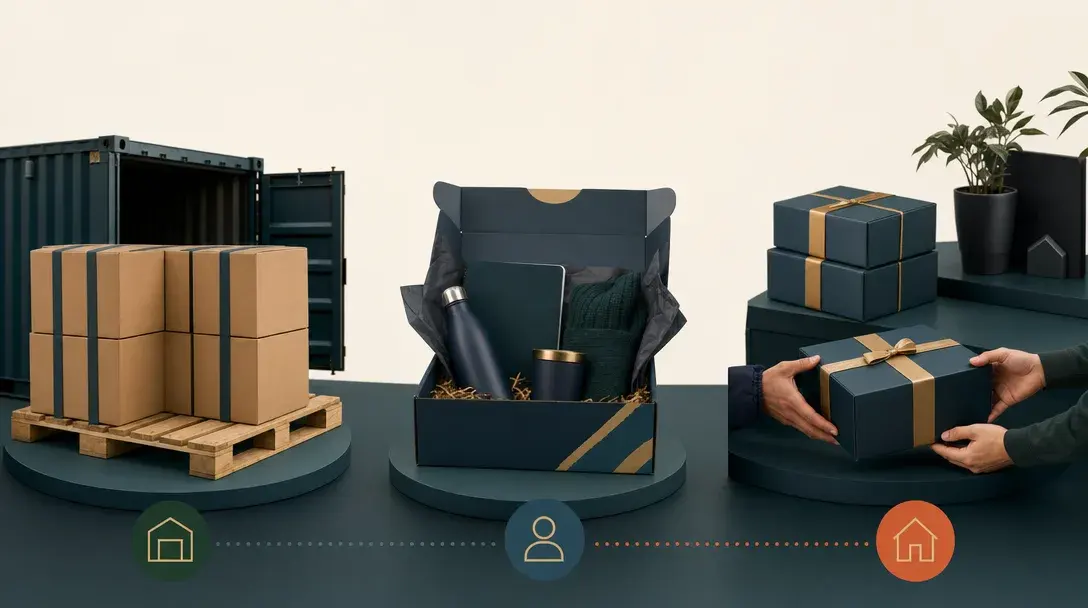
Corporate gifting at scale runs through one of three fulfillment routes: bulk delivery to a few receiving locations, direct parcel shipping to each recipient, or bulk import to a destination fulfillment partner with local dispatch. The right choice turns on handoff ownership, address readiness, packaging fit, and exception control, not carrier price alone, according to KudBo and Brand Sauce.
The routing decision carries more weight than carrier selection. It decides who receives the shipment, who holds the address list, and who answers for a damaged box six weeks later.
KudBo frames the two most common routes as bulk fulfillment, where a small number of receiving locations take delivery and distribute internally, and individual fulfillment, where every recipient gets a separate parcel. Brand Sauce's practical filter for teams split between home and office looks past the cheapest shipping line item: the better destination gets the right item into the recipient's hands with a reasonable total cost, clear timing, and no unnecessary sharing of home addresses.
A third route gets less attention in most coverage of this topic: bulk import to a destination fulfillment partner, who receives the full shipment, then dispatches local parcels from there. That model earns its keep when customs clearance can concentrate in one receiving event rather than scatter across many individual international parcels, and when a local partner can take on storage, kitting, and address corrections closer to the recipient.
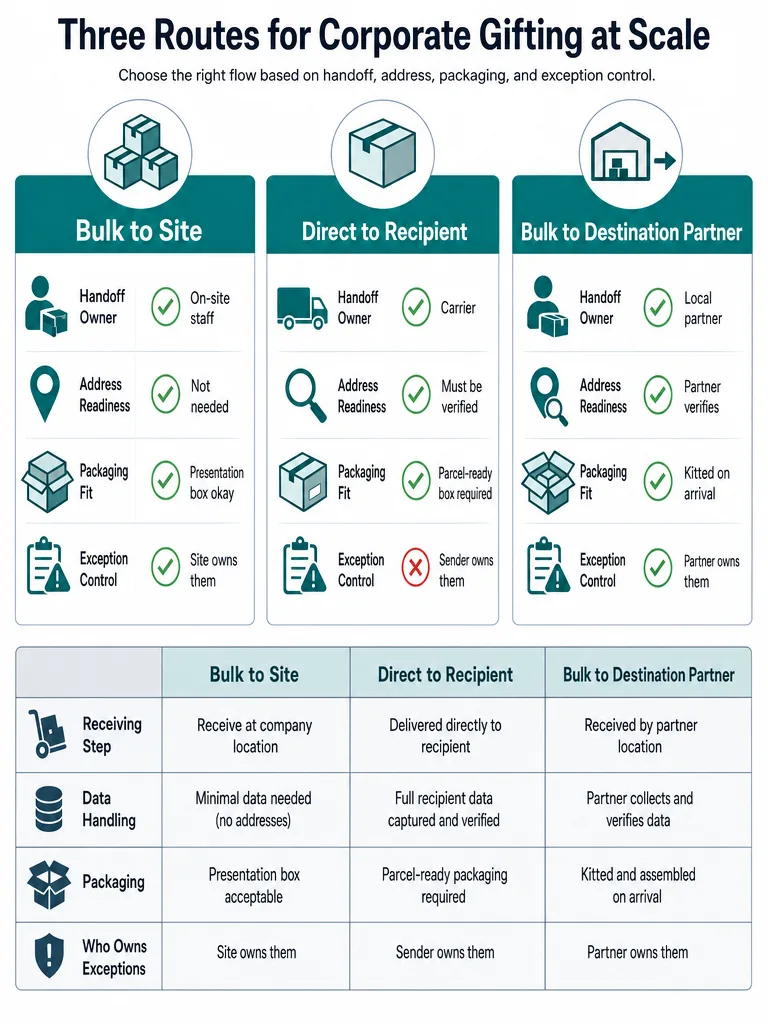
Bulk-to-office, direct-to-recipient, or destination partner: comparing the three routes
Each of the three routes shifts a different piece of work, and the shift matters more than the freight bill. KudBo's framing separates the models by who receives the shipment, who holds recipient data, what packaging has to survive, and who deals with problems after the gifts leave the dock.
In a bulk-to-office model, the factory packs gifts into master cartons shipped to one or a few addresses, and a local team on-site breaks the shipment down and distributes it. Recipient data stays internal, since the sender never needs individual home addresses, and packaging only has to survive a single leg of freight rather than last-mile parcel handling. The cost shifts to the receiving organization, which has to staff the sort-and-hand-out step.
In direct-to-recipient shipping, the fulfillment operation builds a separate parcel for every name on the list. That removes the local distribution step entirely, but it requires complete address data up front, parcel-grade packaging for every unit, and a defined process for what happens when a parcel bounces back or never arrives.
Bulk-to-destination-partner sits between the two: one bulk shipment crosses the border or the country, lands with a partner who holds inventory and local shipping relationships, and that partner dispatches final-mile parcels from a domestic address. It behaves like bulk shipping for the sender and like direct shipping for the recipient.
| Route | Receiving step | Recipient-data handling | Packaging requirement | Who owns exceptions |
|---|---|---|---|---|
| Bulk-to-office | One or few sites receive master cartons | Minimal; no individual home addresses needed | Must survive one freight leg, not parcel handling | Receiving organization distributes and resolves shortages |
| Direct-to-recipient | None; parcels ship straight to each address | Full address list required for every recipient | Must be parcel-ready for every unit | Fulfillment operation handles bounce-backs and reships |
| Bulk-to-destination-partner | Partner receives bulk shipment, then dispatches locally | Addresses needed only at the local dispatch stage | Bulk packaging for transit, parcel packaging at dispatch | Shared between sender and destination partner |
How do you send gifts to multiple addresses without a data cleanup delay?
Direct shipping to recipients only works when the address list is complete, current, and formatted for a shipping label, and most corporate gifting lists aren't. KudBo notes that individual fulfillment requires reliable address data before a program can run on that route at all. When the list has gaps, the program stalls in cleanup rather than in shipping.
Shopify's standard checkout handles one address per order. Giftnote points out that sending 80 gifts to 80 addresses on Shopify requires either a custom-built portal, manual intervention, or a dedicated bulk gifting app layered on top of the default flow. That's a Shopify-specific limitation worth planning around for any program running its gifting flow through a Shopify store; other order systems may handle multi-address sends differently.
When address data is incomplete, stale, or scattered across HR systems and spreadsheets, bulk-to-office or bulk-to-destination-partner routes buy time. They push the per-recipient address problem downstream to a local team or a partner who can chase down corrections closer to delivery, instead of blocking the entire shipment at the sourcing stage.
Gift pack vs. shipping pack: why the box isn't the parcel
A gift pack and a shipping pack solve two different problems, and treating them as the same box is a common planning mistake. The gift pack is what the recipient sees when they open it: branded, presentation-grade, built to look good on a shelf or a desk. The shipping pack is what protects that gift pack in transit.
KudBo's distinction is direct: a presentation box can protect a gift's appearance in storage without being built to survive exposed parcel transit. A rigid lid-and-base box that looks premium sitting on an office table can crush, scuff, or pop open after a conveyor belt and three handoffs between carriers. Programs that skip this distinction often find out the difference when a batch of gifts arrives dented at the recipient's door, not in a warehouse.
Define both specs, the presentation box and the outer shipping carton, before committing to a route. Sorting that out during sourcing, rather than after a shipment arrives damaged, is what keeps a program from redesigning packaging mid-run.
How to route hybrid teams between home and office
Hybrid teams break the assumption that everyone assigned to an office should get an office delivery. Brand Sauce's core point on this is to offer a defined choice between home and office routes rather than defaulting an entire roster to one path based on their listed work location.
- Pull actual attendance, not org-chart assignment. Badge swipes or calendar data tell you who's actually at a desk on a given week better than a roster does.
- Separate production method from delivery destination. Brand Sauce notes these are independent decisions: on-demand production doesn't automatically mean home delivery, and a bulk production run doesn't automatically mean office delivery. A bulk-produced batch can still be split into home parcels.
- Give each route its own allocation. Set a separate quantity and budget line for home shipments and office shipments so one route running short doesn't eat into the other's stock.
- Build separate support paths. A missing home parcel and a missing office carton need different troubleshooting: one is a carrier trace, the other is an internal distribution question.
- Confirm pickup timing before the office batch ships. An office delivery only works if someone is scheduled to be there to receive and hand it out; otherwise it sits in a mailroom past the event date.
Who owns delivery exceptions, reshipments, and leftover inventory?
Exception ownership shifts with the route you pick, and deciding who handles a damaged parcel or a leftover carton matters as much as picking the route itself. KudBo separates two decisions that buyers often treat as one: how much product to purchase and how much to ship at any given time.
A program can buy its full order in a single production run and still release shipments over several weeks, for onboarding kits, staggered event dates, or phased rollouts. That means someone, either the sender, a 3PL, or the destination partner, has to store the remaining inventory between releases and reconcile what's left against what's already shipped. Skipping that step is how programs lose track of stock counts midway through a rollout.
Exception ownership follows the route. In a bulk-to-office model, the receiving site deals with shortages, damaged units, and local redistribution once the carton lands. In direct-to-recipient shipping, the fulfillment operation owns every bounced parcel, wrong address, and reship request, multiplied across however many individual shipments are in flight. In a bulk-to-destination-partner model, that burden splits: the sender is responsible for what happens before the partner takes custody, and the partner owns what happens after.
These routes don't make exceptions disappear. They only decide who answers for handling them when something goes wrong. A program plan that doesn't name an owner for reships and leftover stock before the first carton ships is missing a step, not just a detail.
What changes when a gifting program ships across borders?
Calling a shipment a "gift" doesn't settle how customs treats it, and that assumption causes delays at the border more often than any other single mistake. KudBo is direct on this point: cross-border individual parcels still require proper customs classification and destination-country review regardless of the sender's label or intent.
For a single international parcel to one recipient, that review happens at the border, per package, which multiplies the paperwork and the risk of a held shipment across however many countries the recipient list touches. For a bulk-to-destination-partner route, the import, kitting, and labeling work happens once, at the partner's receiving facility in the destination country, before gifts split into local parcels. That concentrates the customs exposure into a single, predictable clearance event instead of scattering it across many individual international shipments.
When a program's international recipients cluster within a smaller set of destination countries, bulk-to-destination-partner is usually the more predictable path, since customs clearance concentrates into one event at the partner's facility. When recipients are scattered across many different countries with no real concentration, direct parcel shipping with proper customs paperwork per package may be the only workable option, even though it carries more individual clearance risk to manage case by case.
Which corporate gifting platforms handle bulk shipping at scale?
Vendor-reported figures from gifting platforms vary widely on country coverage, gift volume, and pricing, and none of the numbers below are independently verified; they come from each company's own published claims as tracked by Rewordin in August 2026, plus each platform's own site. Treat them as a starting map of scale claims, not a performance guarantee.
| Platform | Vendor-reported coverage | Vendor-reported volume | Published pricing (August 2026) |
|---|---|---|---|
| Snappy | 150+ countries | 10,000+ gift options, 9M+ gifts sent, 5,000+ companies | Free Essential tier; Elevated at $2,000/year |
| Sendoso | 165+ countries | 15M+ sends, 1,000+ options | Not publicly listed |
| Reachdesk | 180+ countries; warehouses in US, EU, Canada, APAC | 8,000+ gifts | Not publicly listed |
| Goody | 140+ countries | 25,000+ companies, 600+ brands | Gifts from $15, no platform fee to start |
| Loop & Tie | Not stated | 500K+ trees planted, 1,000+ small businesses supported | Collections at $30, $50, $75, $100, $250 |
| Giftogram | Not stated | 22,000+ companies, 140,000+ brands stated | Not publicly listed |
| SendAChoice | Not stated | Sends to 50, 500, or 5,000 recipients; 20+ brand choices per recipient | Not publicly listed |
| Sugarwish | Not stated | Not stated | 10% upfront on WishLink sends, remainder billed as recipients redeem |
| Huggg | Not stated | Cycas Hospitality reported a roughly 98% drop in reward-admin time after switching to claimable links | Not publicly listed |
These platforms largely automate the direct-to-recipient route through claimable links or address portals. The available sources here do not describe a bulk-to-destination-partner model with physical import and local kitting, which leaves a gap that a sourcing and logistics partner typically fills instead.
How to choose the right shipping route
The right shipping route depends on four factors, not on which carrier quotes the lowest rate: how many receiving points the program has, how clean the address data is, whether the packaging matches the handling the route requires, and who is named to own exceptions before the first carton ships. Work through these four in order, and the route tends to pick itself.
- Count your receiving points and name an owner. Bulk-to-office works when a small number of receiving locations can distribute the gifts and someone at each site is actually assigned to receive, count, store, and hand them out. Without a named local owner, a bulk shipment just moves the bottleneck from the warehouse to the mailroom.
- Check your address data. If recipient addresses are incomplete, outdated, or scattered across systems, direct-to-recipient shipping will stall on cleanup before it ships anything. Fix the data first, or route around it with a bulk model.
- Match packaging to the route. A presentation box built for a desk doesn't automatically survive a parcel network. Confirm the shipping pack separately from the gift pack before committing to direct shipping.
- Name the exception owner. Decide now who handles a damaged unit, a bounced address, or leftover inventory between shipment waves, whether that's an internal team, a 3PL, or a destination partner.
If the program spans multiple countries, add a fifth step: decide where import, kitting, and labeling happen before the first carton leaves the factory, not after it's stuck at a border.
Landfall Brands sources, packs, and plans delivery dates for gifting programs built on any of these three routes, working from a landed cost and a fixed delivery date rather than a per-unit freight quote.