InsightComparisons12 min read
One Vendor vs Many Suppliers for Retail Categories
Use two tests: total landed cost across the chain and the cost of a supply failure. That makes one vendor, many suppliers, or a hybrid a category-by-category decision.

Should you use one vendor or many suppliers for a retail category?
One vendor vs many suppliers for a retail category comes down to two tests: the total cost added across every link in the supply chain, and the dollar cost if that category's supply fails entirely. A category that scores well on the first test but poorly on the second is a bad candidate for single-vendor consolidation, no matter how attractive the unit price looks.
A category with thin margins and predictable demand usually gains more from cutting links out of the chain than it loses in flexibility. A category tied to a single seasonal window, a promotion, or a launch date carries a different calculus: one bad shipment can wipe out the whole program. The Investopedia entry on vendors notes that manufacturers and retailers try to remove as many links from the supply chain as possible because the final cost of a product rises with each added link. That's the cost argument for consolidation.
The risk argument cuts the other way. A 2004 study in the journal Omega frames supply-side risk in financial terms, noting that physical supply cost can run as high as 30% of total cost of goods sold, which is why the number of suppliers behind a category isn't a back-office detail. It's a margin and continuity decision that deserves its own test, category by category, rather than a company-wide policy.
What's the difference between a vendor and a supplier?
A vendor sells finished goods or services directly to a business or consumer, while a supplier typically sits earlier in the chain, providing raw materials or components used to make that finished product. The distinction matters for retail buyers because contracts, delivery schedules, and inventory accountability live with the vendor relationship, not further upstream.
Investopedia's definition, updated in May 2026, describes a vendor as a party in the supply chain that sells goods and services to companies or consumers, and notes that vendors are commonly confused with suppliers, who provide raw materials for production. Lightspeed's retail-focused breakdown puts it in a single line: vendors sit later in the supply chain and sell finished goods ready for use or resale, while suppliers sit earlier and sell raw materials or components for production. Centric Software, writing for fashion and apparel brands, draws the same line: a vendor sells garments, accessories, or packaging ready for sale, while a supplier provides the fabric, dye, or thread that goes into making them.
For a retail buyer, the practical read is this: when you're deciding between "one vendor" and "many suppliers" for a category, you're really deciding how many of those upstream links you want visibility into, and how many you're willing to let someone else manage on your behalf.
What are the hidden costs of managing multiple suppliers for one category?
Running several suppliers for one category adds coordination work that rarely shows up on a line-item invoice but shows up in margin anyway. Each additional supplier relationship means a separate contract, separate payment terms, and a separate quality standard to track, and Lightspeed's guide to vendor relationships points out that a workable vendor-client relationship depends on clear agreement on pricing, payment terms, delivery schedules, and product specifications, for every party involved.
Multiply that by three or four suppliers in one category and the admin load multiplies with it. Public research doesn't put a precise dollar figure on that coordination cost for retail buying teams specifically, so it's worth being direct about that gap rather than inventing a number. What the research does establish is the scale of the problem it's solving for: a 2017 McKinsey study cited by Centric Software found that more than 80% of surveyed fashion executives listed supplier collaboration and development as a top priority, which signals that managing multiple supplier relationships is widely treated as a drag on execution, even without a standard benchmark for its cost.
The friction that shows up in practice tracks the same two items Lightspeed flags as needing shared agreement across every supplier: delivery schedules and product specifications. When a category runs on several suppliers instead of one, each supplier can be running its own version of both, which is exactly the kind of inconsistency a single clear agreement is meant to prevent.
How much risk is too much with a single vendor?
This article uses a simple test for single-vendor risk: weigh the cost of that vendor failing against the margin the category generates in a comparable period. The research on supply disruption gives real numbers for how large that downside can get. A 2004 analysis published in Omega lays out several documented cases that show disruption cost scales with how concentrated the sourcing is.
- Plant closures hit by the hour, not the week. The Omega article cites large auto manufacturers losing as much as $1 million per hour when a plant closes, a figure that illustrates how fast a single-source stoppage compounds once a line stops moving.
- Physical loss in transit adds up fast. The same research describes a US company shipping food in Mexico that lost $2 million in goods across 49 truck hijackings, a reminder that distribution risk, not just production risk, sits inside the single-vendor calculation.
- Geopolitical exposure can wipe out an entire facility. The article also cites a pharmaceutical company that lost $225 million after the Yugoslav government seized and nationalized its Belgrade property and assets, the kind of tail risk that a single-country, single-vendor setup can't diversify away from.
For a retail buyer, the translation is this: a category tied to one vendor with no qualified backup is exposed to every one of those failure modes with no fallback. That's a tolerable bet for a commodity item with a long shelf life and no fixed delivery date. A category tied to a promotion or seasonal launch adds a date-certain requirement on top of the cost and quality requirements already in play, which is why keeping campaign merchandise on schedule gets treated as its own planning problem rather than a routine purchase order.
One vendor vs many suppliers: a side-by-side comparison
One vendor lowers coordination cost and tightens accountability for landed cost and delivery dates; many suppliers spread disruption risk across more than one source at the cost of added contracts and inconsistent delivery windows. Neither model wins outright across every factor, which is why the comparison below lines the two models up against the factors that actually move a retail buyer's numbers.
| Factor | One vendor | Many suppliers |
|---|---|---|
| Landed cost | Fewer links in the chain to mark up; Investopedia notes final product cost rises with each added link | Each supplier layers its own margin, freight, and handling cost into the category total |
| Delivery risk | Concentrated; a single failure stops the whole category, per the disruption cases in the Omega research | Distributed; one supplier's delay doesn't halt the full assortment |
| Quality control | One standard to audit and enforce | Variance between suppliers; each one needs its own audit cadence |
| Contract complexity | One set of pricing, payment, and delivery terms to manage, per Lightspeed's framing of a vendor-client agreement | Separate terms and renegotiation cycles for each supplier relationship |
| Tier 1/2/3 exposure | Visibility often stops at tier 1 unless the vendor discloses further upstream, per Avetta's tier framework | Multiple tier 1 relationships multiply the tier 2 and 3 risk a buyer has to track |
Avetta's breakdown of supplier tiers is useful here regardless of which model a category uses: tier 1 suppliers are direct suppliers of the final product, tier 2 suppliers are subcontractors to tier 1, and tier 3 sits a level further back, often raw materials. Avetta's own research flags that companies routinely focus on tier 1 and overlook tier 2 and 3, even though upstream suppliers still carry risk and liability back to the buyer. That exposure doesn't disappear under either sourcing model; it just becomes easier or harder to see depending on how many tier 1 relationships are stacked on top of it.
The two-test framework for choosing a sourcing model by category
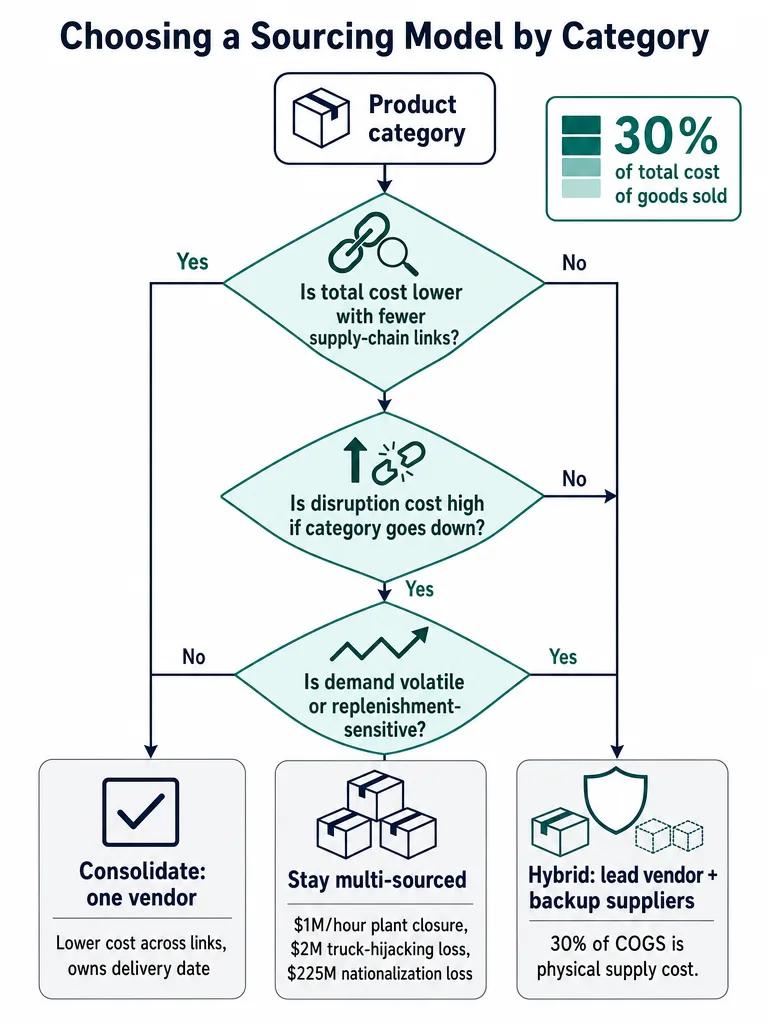
The sourcing decision for any retail category runs through two tests: total cost across every link in the supply chain, and the dollar cost if that category's supply fails. A category that passes the first test (fewer links, lower landed cost) but fails the second (catastrophic if it fails) is a poor candidate for single-vendor consolidation no matter how attractive the cost side looks.
Test one: total cost across links. Investopedia's framing applies directly: manufacturers and retailers try to eliminate as many supply chain links as possible because final product cost increases with each one. A category sourced through four intermediaries, each taking a margin, is carrying cost that a direct, single-vendor relationship can often remove. Under this test, fewer handoffs typically lowers landed cost, all else equal, which is why it tends to favor consolidation on its own.
Test two: at-risk cost. This is where the Omega research on supply disruption becomes a buying tool rather than a textbook citation. If a category's failure mode looks like the $1 million per hour plant-closure example, the $2 million trucking-loss example, or the $225 million nationalization example, that category needs enough supplier redundancy to survive a single point of failure, even if redundancy costs more per unit.
Why this beats a blanket policy. Academic research on sourcing strategy backs a family-by-family approach directly: a risk and benefit analysis of sourcing is more appropriately done at the level of a product family, not a company-wide rule, because different product families carry different cost and risk profiles even inside the same retail business. A private-label household staple and a limited-run seasonal promotional item can sit in the same warehouse and still need opposite sourcing models.
The buyer-level takeaway. Run both tests before assigning a sourcing model to any category. A category that clears the cost test and carries low at-risk cost is a strong candidate for one vendor. A category that clears the cost test but carries high at-risk cost needs a backup supplier qualified in advance, not after the first missed delivery.
Which categories should stay multi-sourced vs consolidate to one vendor?
Categories with high disruption cost or volatile, hard-to-forecast demand hold up better when they stay multi-sourced; categories built around a stable, well-defined spec are stronger candidates to consolidate under one vendor. The split follows directly from the two-test framework above: multi-sourcing buys resilience at the cost of coordination, while consolidation buys cost and control at the risk of concentration.
Stay multi-sourced when:
- The category feeds a promotion, prize fulfillment, or event with a fixed date, where the Omega research's disruption examples (plant closures, transit losses, geopolitical seizures) represent a real, program-ending downside if a single vendor fails.
- Demand swings seasonally or by campaign, making it risky to lock total volume into one vendor's capacity and lead times.
- Replenishment-sensitive SKUs where an out-of-stock has an outsized effect on continuity carry a high at-risk cost by definition, which under the framework above argues for backup supplier coverage rather than a single point of failure.
Consolidate to one vendor when:
- The category runs on a single, stable spec rather than a shifting mix of materials or finishes, which is the scenario where choosing between private label and white label programs usually starts.
- The buying team is already managing multiple contracts, payment terms, and delivery schedules for a category that, per Lightspeed's framing of vendor relationships, could run on a single clear agreement instead.
- The cost test clearly favors fewer links, and the at-risk cost of a disruption is modest, for example a commodity item with a long shelf life and no fixed delivery date.
The pattern across both lists comes from the same place: the decision belongs at the product-family level, not the company level. A retailer can run one vendor for a stable, well-specified category and several suppliers for a volatile seasonal category in the same buying cycle, and both choices can be correct.
Is a hybrid model with one lead vendor and backup suppliers better?
A hybrid model, one lead vendor handling the bulk of a category with qualified backup suppliers held in reserve by item family, is worth building whenever the category clears test one (cost favors consolidation) but doesn't clearly clear test two (at-risk cost is real). It keeps the cost advantage of fewer links while capping the exposure that a pure single-vendor setup carries. Building one takes a specific sequence, not a general policy statement.
- Map the category by item family, not by SKU count. Group items that share tooling, packaging, or raw material so the lead-vendor and backup-vendor assignment matches how the product is actually made, not how it's merchandised.
- Run the two-test framework on each family. Score total cost across links and at-risk cost separately for each item family inside the category; they won't score the same even within one category.
- Assign a lead vendor who owns landed cost and delivery date. The lead vendor should be accountable for the full landed cost, not just unit price, and for a committed delivery date the buying team can plan replenishment or promotion timing around.
- Qualify at least one backup supplier per high-risk family before you need one. Qualification before a disruption, not during one, is what turns "backup supplier" from a plan into a working option.
- Set a trigger for when backup capacity activates. Define the delay, defect rate, or shortfall threshold that moves volume to the backup supplier, so the switch doesn't depend on a judgment call made under deadline pressure.
- Review the split annually against actual performance. A hybrid split that made sense at launch can shift once real delivery and defect data comes in from both the lead vendor and the backups.
Landfall Brands runs this kind of single-vendor program for sellers and retail buyers, covering sourcing, packaging, and import logistics for a category under one relationship built to a landed cost and a delivery date. The buyer still decides, family by family, whether the at-risk cost in that category calls for qualified backup coverage on top of it. Run the two tests on your own category before deciding which model to build around.