InsightGuides10 min read
Private-Label RFQ Checklist: Which Costs Must Be Quoted Separately
Split the RFQ into line items before you compare suppliers. That makes landed cost, timing, and risk visible instead of hiding them in one blended price.

Which costs must be quoted separately on a private-label RFQ?
A private-label RFQ checklist has to separate unit price, samples and tooling, packaging, freight and duties, broker fees, inspections, and the cash impact of payment terms and inventory carrying cost into their own line items, not one blended number. Bundling any of these into a single unit price hides which factor is actually driving your landed cost and makes two suppliers' quotes impossible to compare honestly.
Fastlanetrade's sourcing guide lays out the full list directly: a factory price is only one component of margin, and a real comparison has to account for product cost, sample and development charges, packaging, freight, duties or tariff exposure, broker fees, quality inspections, payment terms, and the carrying cost of inventory. Leave any of these folded into "unit price" and you lose the ability to negotiate a single lever without reopening the whole number.
Which of these land directly in the supplier's quote and which belong in a separate landed-cost worksheet depends on the Incoterm. A quote priced delivered duty paid (DDP) folds freight, customs, and broker fees into one number. A quote priced free on board (FOB) leaves those three outside the supplier's number entirely, for the buyer to add separately. Either way, a comparable RFQ checklist tracks all of them, even when they don't sit on the same document.
Ask every supplier directly what changes when order volume rises, when packaging specs shift, or when a different material gets substituted. A quote that can't answer that question is an estimate, not a quote.
What must be frozen before suppliers can return a comparable quote?
An RFQ is the document a buyer sends to multiple suppliers asking each to price an identical, defined scope. This checklist treats five fields as the ones that have to be locked before two suppliers can return comparable numbers: full product specifications, quantity tiers, destination, delivery window, and packaging requirements. Leave any one of them open and each factory fills the gap with its own assumption.
Fastlanetrade's sourcing guide calls this making quotes comparable before you negotiate: give every supplier a complete brief covering product dimensions, materials, colorways, construction details, artwork, labeling, packaging, required certifications, quantity tiers, target delivery date, and destination.
Packaging deserves its own line in that brief. Racklify's analysis of how retailers build private-label programs notes that packaging functions as the product's primary communication tool and has to satisfy regulatory and retail requirements at the same time: artwork, label copy, country-of-origin statements, barcodes, warning labels, and case configurations that match fulfillment workflows. Confirm which packaging components and which carton requirements the quote actually covers before pricing goes out.
Include more than one quantity tier in the same RFQ. That separates fixed development and setup costs from costs that scale with volume, which tells you whether a lower per-unit number comes from real efficiency or a thinner spec. A quote-ready product specification keeps every supplier pricing the same assumptions.
One-time, per-unit, per-order, and conditional costs: sorting an RFQ line item
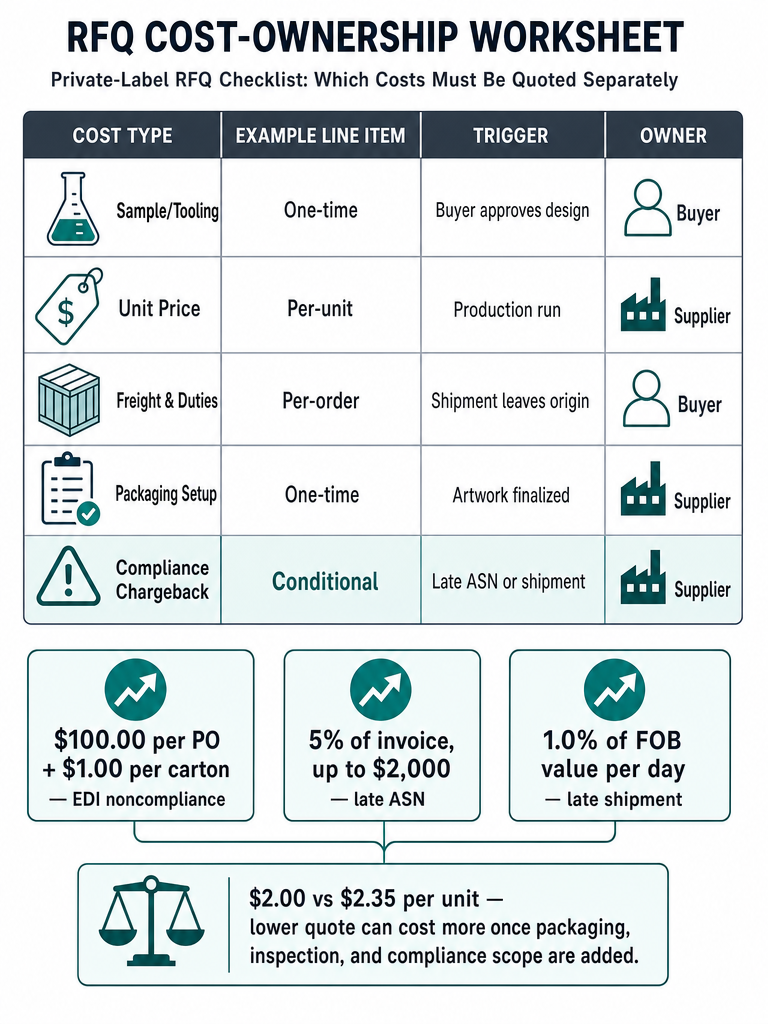
Sorting an RFQ line item into one of four cost types, as laid out in the worksheet below, shows which costs move with volume and which only show up when something goes wrong. Mixing these together on one quote sheet is how two "comparable" bids end up pricing different projects without either side noticing.
| Cost type | Example line items | What triggers it |
|---|---|---|
| One-time | Samples, tooling, molds, artwork setup | Development work before the first production run |
| Per-unit | Base product cost, decoration or branding cost | Scales directly with order quantity |
| Per-order | Freight, customs duties, broker fees, inspections | Triggered each time a shipment moves |
| Conditional | Compliance chargebacks, rework, expedited freight, weight or carton variance fees | Only triggered if something goes wrong after the quote is accepted |
Fastlanetrade's sourcing guide makes the same point from the negotiation side: ask suppliers to separate key cost drivers so you can see what changes when volume rises, when packaging changes, or when a different material is selected. A transparent quote turns a vague request for a discount into a specific lever: order consolidation, standard color options, simplified packaging, revised payment terms, or a committed reorder schedule.
This sorting matters most once a program scales past one order. A blank-versus-decorated import pricing comparison shows how fast a landed cost can shift once setup and decoration are priced apart from the base unit.
Who owns each handoff: specs, artwork, samples, logistics, compliance
This worksheet assigns an owner to each handoff where ownership is easy to leave vague: the specification, artwork, sample approval, freight and customs, and compliance testing. Each one needs a decision on whether its cost sits inside the supplier's quote or outside it, which is where the Incoterm matters most.
| Handoff | Who owns it | In the quote or outside it |
|---|---|---|
| Product specification | Buyer | In the quote; it defines what's being priced |
| Artwork and branding files | Buyer approves, supplier may produce plates/setup | Setup cost in the quote; approval decision outside it |
| Sample approval | Supplier produces, buyer approves | Sample fee in the quote; the approval call is the buyer's |
| Freight and customs | Negotiable by Incoterm | FOB: outside the quote, buyer's cost after loading. DDP: inside the quote |
| Compliance testing and audits | Supplier generates evidence, buyer verifies | Testing cost in the quote; liability for a failed audit is a separate conversation |
Freight and customs ownership depends entirely on which Incoterm the quote is built around. Under FOB, those costs sit outside the supplier's number and become the buyer's responsibility once goods clear the port of origin. Under DDP, the supplier folds freight, duties, and customs clearance into one landed number. IHÄNA Retail Group, a Minneapolis-based private-label sourcing firm founded in 2017, markets DDP terms paired with Net 90 ROG payment, meaning payment isn't due until 90 days after the buyer receives and verifies the goods, not from the invoice or ship date. That structure is one illustrative example of how a quote can shift freight, customs, and payment-timing risk onto the supplier's side of the table instead of the buyer's. It isn't the only model, and the right answer depends on what each side is willing to carry.
Sample approval needs its own checkpoint before any of this matters. Confirm exactly what's being approved at each stage, covered in product samples versus production units.
What compliance costs can appear after production if they weren't scoped in the RFQ?
Compliance chargebacks can show up months after a quote is accepted, and they can erase the savings that made a "cheaper" quote look attractive in the first place. Destination XL Group, Inc. (DXL Group) publishes a private-label vendor manual, effective March 11, 2025 and reissued as a modernized edition in September 2026, that itemizes exactly this kind of exposure for vendors shipping into its supply chain.
The manual also sets a $100.00 minimum charge for inaccurate weight or cubic measurements, plus any incremental freight expense the error causes, and requires facility audits to score a C grade or better before remediation is waived. None of these appear on a standard unit-price quote. They surface only once EDI setup, shipment timing, invoice accuracy, and carton data get tested against a retailer's published compliance manual. An RFQ for a program headed into a managed retail or marketplace channel should ask upfront whether that channel has a compliance manual like DXL Group's, and should name who absorbs each chargeback before the purchase order is cut.
When does a higher quote cost less than the cheaper one?
A quote that's $0.35 higher per unit can be the cheaper option once packaging, inspection, and compliance scope are counted. Dropship Corporation's guide to choosing an Amazon private-label sourcing company walks through this exact comparison: Supplier A quotes $2.00 per unit, Supplier B quotes $2.35, and the higher number can still produce the better business outcome once quality and reliability differences are priced in.
- Set the base unit cost side by side first. It's the number buyers compare instinctively, and the one that hides the most.
- Check what each quote actually includes for materials and construction. A $2.00 quote built on thinner material isn't pricing the same product as a $2.35 quote spec'd to a higher standard.
- Check inspection and defect-rate commitments. A lower price with no inspection plan shifts quality risk onto the buyer, who absorbs it later.
- Check shipping reliability and communication responsiveness. A missed ship date can cost more in lost sell-through than $0.35 a unit ever saves.
- Total the landed cost, not the factory price, before deciding which quote actually wins.
For Amazon FBA sellers this math carries extra weight, since a defect rate that looks small on a spec sheet becomes a listing-level problem once it shows up in return rates and reviews. Choosing one vendor over several suppliers for a category changes how much of that risk any single quote is carrying.
What should a corporate gifting or promotional RFQ include for a fixed delivery date?
A corporate gifting or promotional RFQ needs the program's objective, quantities, specs, branding, packaging, destination, and an itemized cost breakdown locked before a supplier can quote to a fixed arrival date. The delivery date itself has to stay separate from production and transit timing, or a freight delay quietly eats into the schedule and the shipment misses its occasion.
- Program objective and occasion, since a client-appreciation gift, a sales incentive, and a holiday program each drive a different product mix and timeline.
- Recipient group and total quantity, plus any size or variant tiers.
- Product specifications, with reference samples or comparable products where possible.
- What's fixed and what's open, so the supplier knows which specs can flex if it lowers landed cost.
- Branding details: logo files, color codes, placement, and decoration method.
- Packaging, inserts, and kitting, stating plainly whether multiple items need to ship combined in one kit.
- Destination and delivery model: a single bulk shipment to one dock, or multiple addresses.
- A must-arrive delivery date, kept separate from production timing and transit timing.
- Sample approval requirements and an itemized cost breakdown covering product, branding/setup, samples, packaging, freight, and taxes, with the quote currency and what's included or excluded stated outright.
How to turn this checklist into one sourcing brief
Everything above becomes useful only once it's compiled into a single document that every supplier sees at the same time. A sourcing brief built this way lets you compare quotes on price, scope, and timing instead of guessing which assumptions each supplier filled in on its own.
- Compile the frozen fields into one specification: product, dimensions, materials, quantity tiers, destination, and delivery window.
- Attach the cost-ownership worksheet, with every one-time, per-unit, per-order, and conditional cost named as its own line.
- Assign an owner to each handoff: who approves artwork, who approves samples, who books freight, who carries compliance risk.
- Set a landed-cost target and a required delivery date as two separate numbers, not one blended guess.
- Send the identical brief to every supplier under consideration, so every quote prices the same scope.
Before sending it, confirm whether the program actually needs private label vs white label terms, since that choice changes who owns the spec and the branding line items in the first place.
Once that brief exists, it works the same way for a marketplace private-label launch, a retail chain's category review, or a fixed-date corporate gifting program.