InsightHow-to9 min read
Product Samples vs Production Units: What to Approve Before You Order
A sample proves the design works; a production run proves the factory can repeat it at line speed, volume, and cost. Use separate approvals for each stage.
What's the difference between a product sample and a production unit?
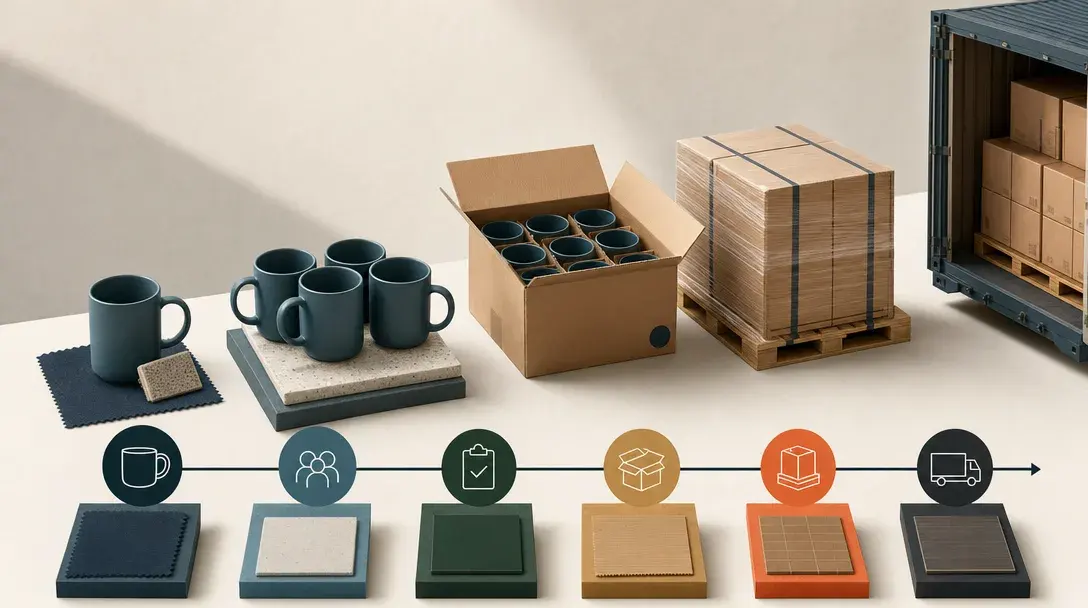
A product sample confirms design, materials, and basic function on one or a few hand-finished units; a production unit has to prove that same result holds up at full line speed, volume, and cost. Product samples vs production units is a distinction between proving a concept and proving a repeatable process, and the two need separate sign-offs, not one approval.
A sample is usually built by a factory's most skilled hands, on a small scale, with time to fix small problems before anyone outside the sample room sees the item. SVI Global, a sourcing quality firm, describes this as the special conditions a sample gets that a production line never repeats: selected materials, no speed pressure, and inspection on every piece in a run of one or a few units.
A production unit comes off a line running at target output, built by a mixed-skill workforce pulling from multiple material batches against a delivery deadline. SVI Global's comparison points to inspection coverage as the clearest gap between the two: a sample gets checked piece by piece, a production lot gets checked in-process and by sampling, so defects can escape that a sample stage would have caught.
A sample proves a design works; a production run has to prove a factory can build it the same way, thousands of times, at the agreed cost. A product sample, in sourcing terms, is a hand-finished or near-final unit used to confirm a design decision before it is locked. Confusing that confirmation with a production guarantee is where most quality disputes start.
Which sample stage are you actually approving?
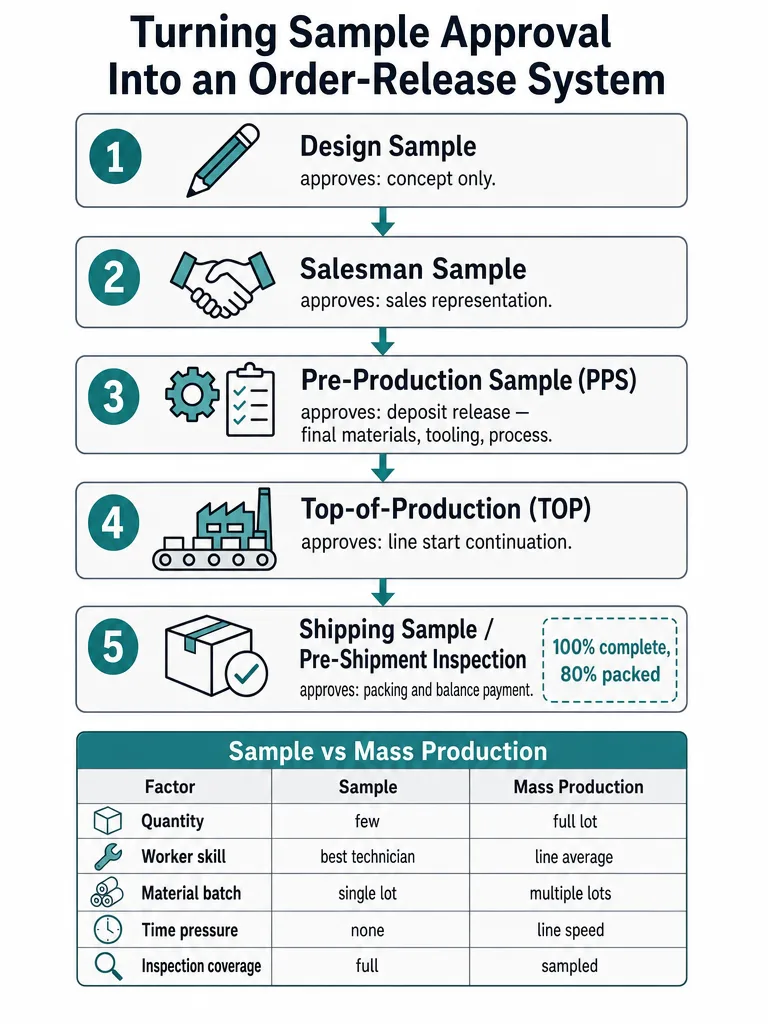
Five sample stages run between a design idea and a shipped container, and each one authorizes a different next step, not the same approval repeated five times. Importivity, a pre-production sampling service, lays out the proto/design sample, salesman sample, pre-production sample (PPS), top-of-production (TOP), and shipping sample as the standard sequence, and ties each one to a specific financial or operational release.
| Stage | Made by | What it proves | Approve before |
|---|---|---|---|
| Proto/design sample | Factory R&D or sample room, often hand-built | Concept, basic dimensions, materials, aesthetics | Moving to tooling or production molds |
| Salesman sample (SMS) | Sample room, sometimes partial production tooling | A presentable look for buyers, not final tolerances | Showing to buyers, taking pre-orders |
| Pre-production sample (PPS) | Production line, using final tooling, materials, and process | The production setup can hit your spec | Releasing the production deposit, starting mass production |
| Top-of-production (TOP) | First units off the actual run | Today's output still matches the approved PPS | Packing and shipment |
| Shipping sample | Random pull from finished, packed goods | Packed quantity, labeling, condition after handling | Authorizing the balance payment and loading |
Importivity is direct about the most expensive mistake in this sequence: do not release the production deposit until a signed-off PPS is in hand. Approving a salesman sample or a proto and treating it as production-ready skips the one stage built specifically to prove the production line, not just the design, is ready.
Why do perfect samples still fail at mass production?
A sample and a mass-production lot verify different things, which is why an approved sample can still produce a bad run. SVI Global frames this as a repeatability problem: a sample is made under conditions a production line cannot reproduce at scale, and the gap shows up across five factors.
| Factor | Sample stage | Mass production | Typical risk |
|---|---|---|---|
| Quantity | One or a few units | Hundreds to thousands or more | Consistency gets harder to hold |
| Worker | Skilled sample maker or expert | Assembly line, mixed skill levels | Technique and execution drift |
| Materials | Selected or limited batch | Multiple production batches | Color or performance variation |
| Time pressure | No speed pressure, flexible adjustments | Output targets, deadline pressure | Process shortcuts |
| Inspection | Near 100% unit by unit | In-process and sampling-based | Defects escape to the lot |
The pattern underneath every row is the same: factories put their best people and most careful attention on the sample, then run the order with a different crew, different timing, and different inspection coverage. A pre-production sample is supposed to close that gap by being built on the actual line, with the actual tooling and materials, under the actual process the order will run on. That is what separates a PPS from an earlier, hand-finished sample that only answers whether the design works.
Golden sample vs counter sample vs approved sample: what's the difference?
A golden sample, a counter sample, and an approved sample are three different things, not three names for one item. TradeAider, a sourcing and inspection firm, defines the golden sample as the locked production reference: the physical unit that inspectors compare every production lot against once it is signed off.
A counter sample is the factory's own interpretation of the buyer's requirement, submitted for review before it becomes the golden sample. It shows what the factory thinks the spec means, which is why it needs a buyer's eyes before it gets locked in.
An approved sample reflects the buyer's acceptance status at a point in time, nothing more. It is a decision, not a quality guarantee. An approved sample can still miss a tolerance, a label detail, or a packaging requirement if the approval itself was not scoped against a written specification. Treating "approved" as a synonym for "defect-free" is a common and costly misread; it only means someone signed off on that unit, at that stage, against whatever criteria were actually checked.
What should you approve before releasing the production deposit?
Releasing a production deposit against anything short of a written specification and a locked reference sample invites a factory to fill the gaps on its own terms. Four approvals belong in place before that deposit moves, each one closing a specific point of ambiguity that shows up later as a dispute.
- A written specification with measurable tolerances. Dimensions, materials, performance criteria, and acceptable variance ranges, documented, not implied by a sample alone. A product specification that manufacturers can quote accurately gives both sides the same numbers to build and inspect against.
- Final materials and components. The PPS should use the same materials, parts, and suppliers the mass-production run will use, not placeholders swapped in for the sample stage.
- Packaging, labels, carton marks, and inserts. The approved unit should include the full saleable package, not just the product inside it. Logos, printed colors, carton markings, and included inserts all need sign-off before deposit, since a correct product in incorrect packaging still fails on arrival.
- One dated revision record that supersedes prior samples. Keep a single, current reference and mark every earlier sample as superseded in writing.
What can still change after you approve a sample?
Approval on a sample does not freeze a factory's sourcing decisions unless the buyer says so in writing. Materials, components, and packaging can get substituted after sign-off, sometimes for legitimate reasons like a supplier running short on a specific material lot, and that substitution should trigger a reapproval step, not a silent swap.
Two checkpoints exist specifically to catch that kind of drift before it reaches a container. The top-of-production (TOP) pull, taken from the first units off the actual run, checks whether what the factory is producing today still matches the approved PPS, per Importivity's five-stage sequence. A pre-shipment inspection (PSI) comes later and compares the finished lot against the correct reference sample and the written specification.
A substitution found at TOP is a line-start problem. The same substitution found at PSI is a shipment problem, with far less room to fix it.
Prototype, pilot run, or full production: how many units should you approve at each stage?
The right question to ask a supplier isn't "can you make this," it's "show me what you'd build at the next volume up, and what passes." Fictiv, a manufacturing platform, frames prototype and pilot builds as two different proof points before full production: a prototype run typically covers 1 to 25 units to validate a design, while a pilot production run typically covers 30 to 300 units built on full production parameters to validate that the process itself repeats.
| Stage | Typical quantity | What it should pass | Tooling cost and lead time |
|---|---|---|---|
| Prototype | 1-25 units (Fictiv) | Design function, fit, basic materials | Prototype tooling: $500-$3,000, 1-2 weeks (RPM Fast) |
| Bridge/pilot run | 30-300 units (Fictiv); bridge tooling suited to 100-10,000 parts (RPM Fast) | Cpk ≥ 1.33, target yield, documentation complete (Fictiv) | Bridge tooling: $1,000-$10,000+, 1-3 weeks (RPM Fast) |
| Full production | 10,000+ parts (RPM Fast) | Sustained yield at line speed, inspection sampling plan | Production tooling: $10,000-$100,000+, 8-20 weeks (RPM Fast) |
These figures come from injection-molded, hard-tooled production, where Fictiv and RPM Fast publish quantity and cost ranges. The available sources here do not provide equivalent soft-goods benchmarks; buyers sourcing apparel, textiles, or other soft goods should ask suppliers directly for pilot-run size and defect-rate criteria rather than assume the hard-tooling numbers transfer.
How to turn sample approval into a production go/no-go checklist
Sample approval only works as quality control if each sign-off triggers a specific release, not a general sense that things look fine. Build the sequence as a checklist tied to money and schedule, not just to physical samples.
- Design sample approved → move to tooling. This confirms concept, dimensions, and materials; it does not authorize spend on production tooling until the buyer signs off in writing.
- PPS approved → release the production deposit. This is the binding quality benchmark; nothing about mass production should start before this sign-off, per Importivity's sequence.
- TOP pull matches PPS → authorize packing and shipment. If the TOP pull shows drift from the approved PPS, packing stops for review before goods move toward a container built against a mismatched standard.
- Shipping sample and PSI pass → authorize the balance payment and loading. This is the last correction point before the goods are loaded, so it should gate the final payment, not follow it.
Each gate controls a different risk. The revision record keeps an old sample from quietly becoming the production reference. Deposit release ties money to a verified production setup rather than a good-looking prototype. TOP and PSI give you two separate chances to catch material or packaging drift before a container closes. Skip any one gate and the leverage that stage was built to provide goes with it.
The order doesn't change with order size or supplier count; only the amount of paperwork does. Readers deciding how much control to keep over the specification these approvals are checked against should also see private label vs white label, since that choice determines who owns the revision record in the first place.